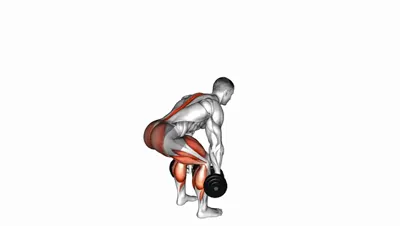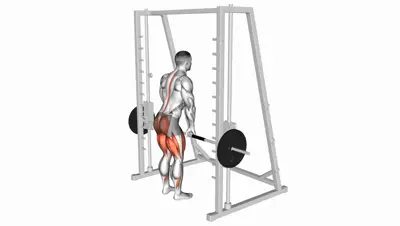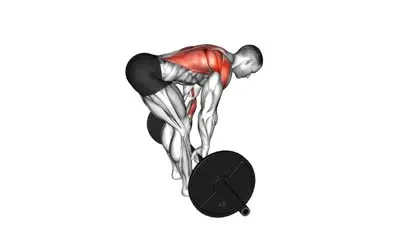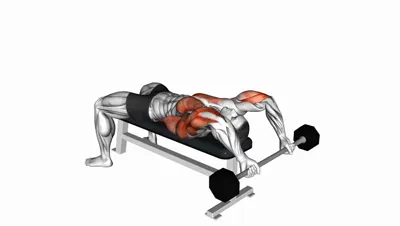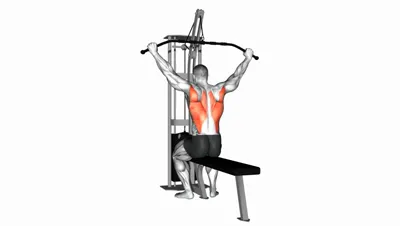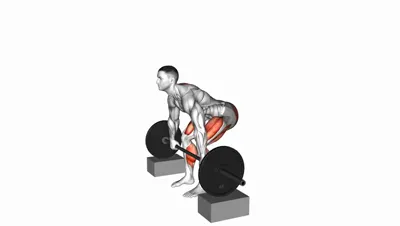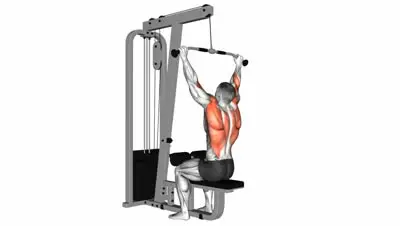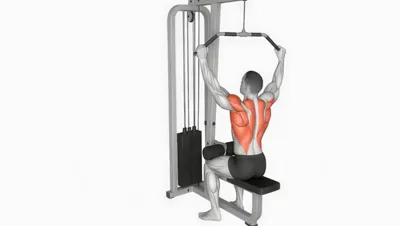

Description
The barbell deadlift is the most demanding compound lift in resistance training — a hip-hinge movement that loads the back, hamstrings, glutes and entire posterior chain in a single explosive pull. As the third lift of powerlifting alongside the squat and bench press, the deadlift develops raw pulling strength faster than any other exercise and translates directly to real-world strength expression. Performed with proper bracing and bar path, it builds total-body mass, grip strength and bracing capacity that carries into every other lift in the gym.
How to perform
- Set your feet under the bar Walk up to the bar with mid-foot directly under it. Set your feet hip-width apart, toes pointed slightly outward. The bar should be about an inch from your shins.
- Hinge down and grip Hinge at the hips and bend your knees just enough to grip the bar — overhand grip just outside your legs (or mixed grip for max attempts). Keep your arms straight.
- Set your back and brace Pull your shoulder blades back and down, take a huge belly breath into your braced core, and lift your chest. Your hips should be higher than your knees and your back flat.
- Drive the floor away Drive through the entire foot and pull the bar up by extending the hips and knees together. The bar should travel in a straight vertical line, dragging up your shins and thighs.
- Lock out at the top Stand fully upright at the top with hips extended, glutes squeezed and shoulders set — do not lean back or hyperextend the lumbar spine.
- Lower under control Reverse the movement under control. Hinge at the hips first, then bend the knees once the bar passes them, and set the bar back on the floor with the same back position you started in.
- Reset between reps Reset between every rep — bracing and back position must be re-established before the next pull. Touch and go is acceptable for moderate loads, full reset for heavy work.
Tips
- Grind your heels into the floor and 'push the floor away' instead of pulling the bar up — shifts the mental cue from back-strain to leg drive.
- Use chalk for any working set — sweat plus a heavy bar equals a slipping bar, which destroys back position.
- Train the deadlift only 1× per week as a heavy primary lift — its recovery cost is far higher than the squat or bench.
- Use straps for back-volume work above 6 reps so grip is not the limiting factor — but pull mixed-grip without straps for working strength sets.
- Reset position between every single rep on heavy sets — bouncing heavy weight off the floor is the #1 cause of deadlift back injuries.
Common mistakes
- Rounding the lower back at lift-off — the single most dangerous mistake in the gym. Brace harder and lower the weight if your back rounds.
- Hips shooting up before the bar leaves the floor — converts the deadlift into a stiff-leg deadlift and overloads the lower back.
- Pulling the bar away from the body instead of dragging it up the legs — increases the moment arm and overloads the lumbar spine.
- Hyperextending at the top — leaning back violently at lockout compresses the spine. Stand tall, glutes squeezed, neutral spine.
- Bouncing the bar off the floor between reps — destroys bracing and is the leading cause of cumulative back tweaks.
Recommended sets & reps
| Sets | Reps | RIR | |
|---|---|---|---|
| Strength | 3–5 | 1–5 | 1–2 |
| Hypertrophy | 2–3 | 5–8 | 1–2 |
| Endurance | 2–3 | 8–12 | 2–3 |
| Power | 3–5 | 1–3 | 1–2 |
Deadlift volumes are intentionally lower than for squat or bench — the lift is uniquely fatiguing on the central nervous system. Stick to 1× per week as a primary lift. Pair with 2–3 secondary pulls (rows, RDLs) per week to reach ~10–20 weekly sets for the back. Volume guidance based on Schoenfeld 2017 + Pelland 2025.
Benefits
Builds total-body strength and posterior-chain mass faster than any other lift in the gym. Develops the entire back — lats, traps, erectors, rhomboids — as a single integrated unit, plus hamstrings and glutes through hip extension. Builds grip strength and forearm hypertrophy as a free side-effect. Strengthens the bracing capacity of the core under maximal axial load — translates directly to better squats, presses and athletic performance. Provides one of the clearest strength benchmarks in lifting and remains plate-loadable for decades of progressive overload.
Frequently asked questions
Sumo vs conventional deadlift — which should I use?
Both are valid for hypertrophy and strength. Conventional emphasizes the lower back, glutes and hamstrings; sumo emphasizes the quads, glutes and adductors with a shorter range of motion. Pick the variation that matches your hip structure — short femurs and wide hips often pull better sumo, long femurs and narrow hips often pull better conventional.
How often should I deadlift?
Once per week as a heavy primary lift is optimal for most lifters. Pair it with 2–3 secondary posterior-chain movements (RDLs, rack pulls, snatch-grip work) on different days to accumulate volume without crushing recovery.
Should I deadlift with a belt?
Yes, above 80% 1RM. A belt increases intra-abdominal pressure and reduces lumbar shear stress on heavy attempts. Train belt-less below 80% to build natural bracing capacity.
Is the deadlift dangerous for my back?
The deadlift is dangerous only when performed with a rounded lower back, hyperextension at lockout, or bouncing reps. Performed with a flat braced back, hip-hinge mechanics and full reset between reps, it is one of the safest and most beneficial lifts you can train. Lower the weight if form breaks — ego-pulling is the leading cause of injury.
Educational guidance only — not a substitute for in-person coaching. Train within your ability and use a spotter for heavy attempts.