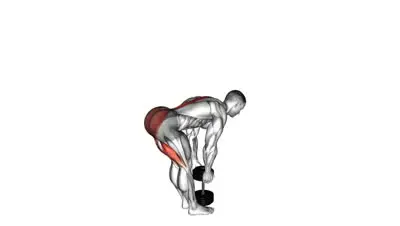

Description
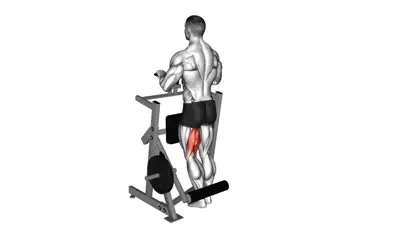
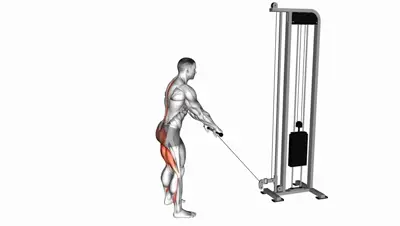
The cable standing leg curl attaches an ankle cuff to a low pulley and curls one leg at a time against constant cable tension while you stand. Unlike seated and lying machine curls, the cable keeps resistance on the hamstring through the entire arc — including the fully lengthened start where machines often lose tension — and trains each leg independently, exposing side-to-side differences. It needs no dedicated leg curl machine, only a cable stack and a cuff, making it the go-to hamstring isolation in busy or minimally equipped gyms. Your standing hip and core stability work quietly in the background on every rep.
How to perform
- Attach the cuff and set up Strap an ankle cuff to one ankle and clip it to the lowest pulley setting. Face the cable stack and step back until the cable is taut.
- Find your support and stance Hold the machine frame or a sturdy upright with both hands. Stand tall on your support leg with a soft knee, hips square to the stack.
- Set your working thigh Shift your weight onto the support leg and let the working leg hang slightly behind you — your thigh stays vertical and still for the whole set.
- Curl your heel toward your glutes Bend the working knee and pull your heel up toward your glutes as far as you can without your thigh drifting forward or your hips rotating.
- Squeeze hard at the top Pause for one second at maximum knee flexion and consciously squeeze the hamstring before beginning the descent.
- Lower slowly and switch legs Extend the knee back to the start over two to three seconds, keeping cable tension the whole way. Finish all reps, then switch the cuff to the other ankle.
Tips
- Keep the working thigh vertical and frozen in place — every centimeter it swings forward turns hamstring work into hip-flexor momentum.
- Lean slightly forward from the hips if you want a stronger stretch on the hamstring at the bottom of each rep.
- Start with your weaker leg and match reps with the stronger one — the unilateral setup is your chance to close the gap.
- Use a lighter stack setting than you would on a seated curl machine; the standing position punishes heavy loads with immediate form breakdown.
Common mistakes
- Swinging the thigh to lift the weight — kicking the knee forward and back generates momentum from the hip instead of the hamstring; pin the thigh vertical and move only the lower leg.
- Rotating the hips toward the working side — twisting opens the hip and shifts the line of pull; keep both hip bones facing the cable stack squarely.
- Standing bolt upright on a locked support knee — a hyperextended knee takes the stabilizing muscles out and stresses the joint; keep the support knee softly bent.
- Letting the stack yank the leg back down — a fast, passive negative wastes the phase where the cable's constant tension helps most; resist for two to three seconds.
Recommended sets & reps
| Sets | Reps | RIR | |
|---|---|---|---|
| Strength | 3 | 8–10 | 1–2 |
| Hypertrophy | 3–4 | 10–15 | 1–2 |
| Endurance | 2–3 | 15–20 | 2–3 |
| Power | 3 | 8–10 | 2–3 |
Reps count per leg — finish all reps on one side before switching, starting with the weaker leg. These are working sets only; add 1 light warm-up set per leg and train hamstrings 2× per week within ~10–20 weekly sets (Schoenfeld 2017, Pelland 2025).
Benefits
Keeps constant tension on the hamstring through the full range of motion, including the lengthened position where machine cam profiles often go slack — and long-muscle-length tension is a key hypertrophy driver. Trains each leg independently, revealing and correcting strength differences that bilateral machine curls hide. Requires nothing but a cable stack and an ankle cuff, so you can isolate your hamstrings in any gym, at home with a pulley setup, or when every leg curl machine is taken. The standing position adds a low-level balance and hip-stability demand that seated curls remove entirely, giving your glute medius and core light extra work for free.
Frequently asked questions
Is the cable standing leg curl as effective as a machine leg curl?
For hamstring isolation, yes — the constant cable tension arguably loads the stretched position better than many machines. Machines allow heavier absolute loads, so many lifters use both: machines for heavy work, cables for strict unilateral volume.
What can I use if my gym has no ankle cuff?
Most gyms hide them near the cable stations — ask staff first. Failing that, a padded D-handle looped around the ankle works in a pinch, or substitute a Swiss-ball leg curl or Nordic curl negative for the session.
Why do I feel this in my lower back?
You are likely swinging the thigh or arching the back to move a too-heavy stack. Lower the weight, hold the support firmly, keep your core braced and move only the lower leg — the hamstring should do all the visible work.
How heavy should I go on standing cable leg curls?
Light enough that the thigh never drifts and the hips never rotate — for most lifters that is a moderate stack setting in the 10–15 rep range. This is a precision exercise, not a load exercise.
Educational guidance only — not a substitute for in-person coaching. Train within your ability and use a spotter for heavy attempts.