
Description
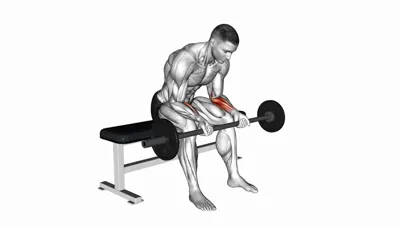
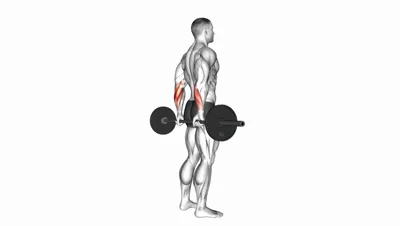
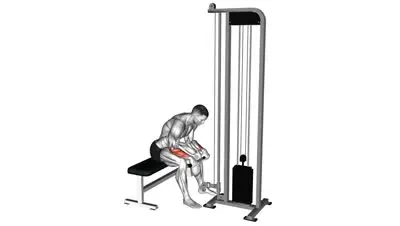
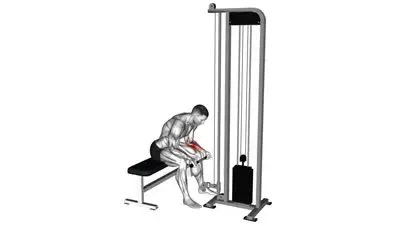
The EZ bar reverse preacher curl flips your grip to palms-down and braces your upper arms on a preacher pad, shifting the work from the biceps to the brachioradialis, brachialis and the forearm extensors. The angled EZ bar makes the pronated grip far friendlier on the wrists than a straight bar, while the pad eliminates the body English that usually creeps into reverse curls. Expect to use noticeably less weight than in a regular preacher curl — the reverse grip is mechanically weaker by design, and that is precisely why it builds the forearms and elbow flexors so effectively.
How to perform
- Set your armpits on the pad Adjust the seat so your armpits sit snugly against the top of the preacher pad and your upper arms rest fully on the sloped surface.
- Grip the EZ bar palms-down Take the angled sections of the EZ bar with an overhand grip at shoulder width, wrists straight and thumbs slightly higher than your pinkies.
- Start from a controlled stretch Lower the bar until your elbows are almost fully extended, keeping the backs of your upper arms in contact with the pad.
- Curl without lifting your arms Curl the bar up in a smooth arc until your forearms are just short of vertical, pressing your upper arms into the pad the entire time.
- Hold the top for a beat Pause for one second at the top with your wrists still straight — do not let them flex backward as the bar rises.
- Lower slowly to the stretch Take two to three seconds to lower the bar back to the near-straight position, resisting all the way down instead of dropping into the turnaround.
Tips
- Keep your wrists locked in a straight line with your forearms — the moment they collapse backward, the forearm extensors give up the exact work they should be doing.
- Use about half of your regular preacher curl weight to start; the pronated grip is much weaker, and pushing heavy loads here only breaks form.
- Focus on the lowering phase — the reverse grip biases muscles that respond well to slow, controlled eccentrics.
- Grip the bar on its angled sections rather than the straight center — that slight wrist angle is what makes the EZ bar version so much more joint-friendly.
Common mistakes
- Letting the wrists hyperextend under the load — a collapsed wrist shifts stress into the joint and out of the forearm muscles; keep knuckles pointing up and wrists straight.
- Loading the bar like a regular curl — the reverse grip handles far less weight, and oversized loads force the shoulders and back to help; drop the ego and the plates.
- Lifting the upper arms off the pad at the top — hoisting the elbows recruits the front delts and releases muscle tension exactly at peak contraction; keep arms glued down.
- Rushing the negative — dropping the bar back to the start skips the eccentric stimulus the brachioradialis responds to most; lower in two to three seconds.
Recommended sets & reps
| Sets | Reps | RIR | |
|---|---|---|---|
| Strength | 3 | 8–10 | 1–2 |
| Hypertrophy | 3–4 | 10–15 | 1–2 |
| Endurance | 2–3 | 15–20 | 2–3 |
| Power | 3 | 8–10 | 2–3 |
As a small-muscle isolation, this responds best to moderate loads and strict form — heavy singles have no place here. These are working sets only; add 1 light warm-up set and train it 2× per week within your ~10–20 weekly sets of elbow-flexor volume (Schoenfeld 2017, Pelland 2025).
Benefits
Builds the brachioradialis and forearm extensors — the muscles that give the lower arm its size and density — better than almost any standard curl, because the pronated grip forces them to lead the movement. The preacher pad locks your upper arms in place, removing the swing and shoulder assistance that usually dilute reverse curls done standing. Strengthens the grip and wrist stabilizers in a controlled range, which quietly improves your deadlifts, rows and pull-ups. The EZ bar's angled grip lets you train the pronated position hard without the wrist discomfort a straight bar often causes, making consistent progressive overload realistic.
Frequently asked questions
What is the difference between reverse preacher curls and regular preacher curls?
The grip. Palms-down shifts the emphasis from the biceps to the brachioradialis, brachialis and forearm extensors. The movement path is identical — only the muscles doing most of the work change.
Why is my reverse curl so much weaker than my normal curl?
That is expected — the pronated grip puts the biceps at a mechanical disadvantage, leaving smaller muscles to do the lifting. Most lifters use roughly 50–60 percent of their regular preacher curl weight.
Can I do this with a straight bar instead of an EZ bar?
You can, but the fully pronated straight-bar grip puts more strain on the wrists. The EZ bar's angled sections reduce that stress while training the same muscles, which is why it is the standard choice.
Do reverse preacher curls really grow the forearms?
Yes — the brachioradialis is one of the biggest muscles of the forearm, and this exercise loads it directly through a full range. Pair it with wrist curls if you want complete forearm development.
Educational guidance only — not a substitute for in-person coaching. Train within your ability and use a spotter for heavy attempts.