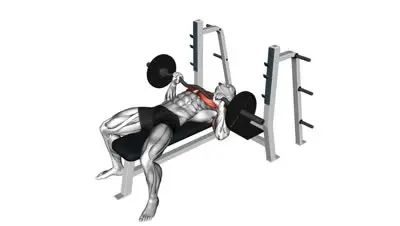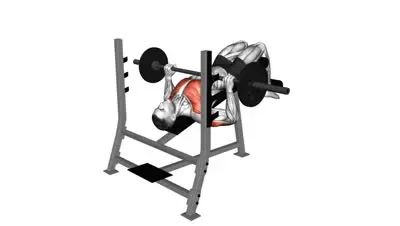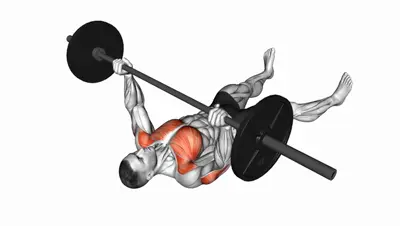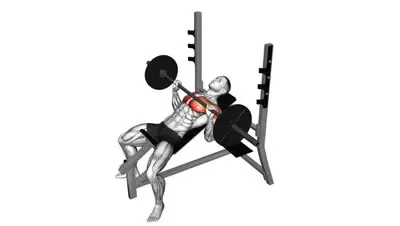

Description
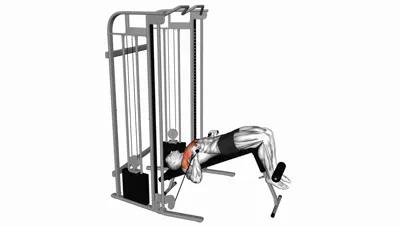
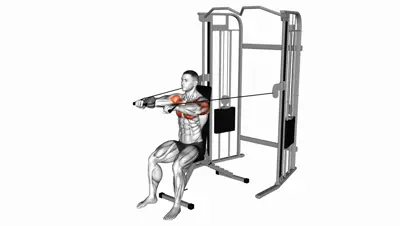
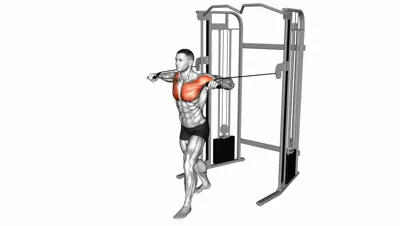
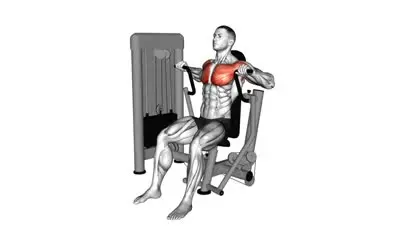
The cable incline bench press trains the upper chest under constant cable tension. Set on an incline bench between two low pulleys, you press the handles up and slightly inward, loading the clavicular (upper) fibres of the pec along with the front delts and triceps. Unlike a barbell, the cables keep tension on the chest at every point in the range — including the top, where a free weight unloads — and allow the hands to converge for a stronger peak contraction. It is an excellent upper-chest hypertrophy tool that is easy on the shoulders and lets you chase a deep stretch and a hard squeeze on every rep.
How to perform
- Set the pulleys low Set both cable pulleys to the lowest position and place an incline bench (about 30–45°) centered between them. Select a moderate weight on each side.
- Grab the handles and sit back Take a handle in each hand, sit back on the incline bench, and bring the handles to the bottom of your chest with elbows bent and tucked to roughly 45° from the torso.
- Set your shoulders and brace Pull your shoulder blades down and back into the bench and brace your core. The cables should already be pulling your hands into a stretch across the upper chest.
- Press up and inward Press the handles up and slightly toward each other, finishing with the hands converging above your upper chest. Squeeze the pecs hard at the top where the cables keep the tension on.
- Lower to a stretch Lower the handles under control back to chest level, letting the upper chest stretch without flaring the elbows past 90°. Keep constant tension on the cables throughout.
- Keep tension between reps Do not rest the handles or let the stack settle at the bottom — keep the pecs loaded and start the next rep from the stretched position.
Tips
- Let the hands converge at the top — bringing the handles together is the cable's advantage over a barbell and maximizes the peak contraction.
- Keep the cables taut at the very bottom; the constant-tension stretch on the upper pec is exactly what a barbell loses at lockout.
- Set the incline around 30–45° — steeper than that drifts the work onto the front delts and away from the upper chest.
- Tuck the elbows to about 45° rather than flaring them to protect the shoulder while still hitting the clavicular fibres.
- Control the eccentric and resist the cables pulling your hands apart — fighting that line of pull is part of the stimulus.
Common mistakes
- Setting the incline too steep — a near-vertical bench turns the press into a shoulder exercise and removes the upper-chest emphasis.
- Not letting the hands converge — pressing straight up like a barbell wastes the cable's unique peak-contraction advantage.
- Flaring the elbows to 90° — overloads the shoulder joint and shifts work off the chest. Keep a roughly 45° tuck.
- Letting the stack rest at the bottom — releasing tension between reps removes the constant-tension benefit of training with cables.
- Going too heavy — a load you can only move by arching off the bench and shrugging means the chest stops doing the work.
Recommended sets & reps
| Sets | Reps | RIR | |
|---|---|---|---|
| Strength | 3–4 | 6–8 | 1–2 |
| Hypertrophy | 2–3 | 8–12 | 1–2 |
| Endurance | 2–3 | 12–15 | 2–3 |
| Power | 3–4 | 5–6 | 1–2 |
These ranges are working sets only — add 1–2 progressive warm-up sets before each working set. Pair with 2× per week frequency to reach ~10–20 weekly sets for the chest, the volume range supported by current evidence (Schoenfeld 2017, Pelland 2025).
Benefits
Targets the upper chest more directly than a flat barbell press while keeping constant tension on the pecs through the entire range — including the top, where a free weight unloads. The converging cable path lets the hands come together for a peak contraction a barbell cannot match, and the deep stretch at the bottom loads the clavicular fibres where they grow. Because the cables guide the line of pull, the shoulders stay in a friendlier position than under a heavy barbell, making it a joint-sparing upper-chest builder. It is easy to load in small increments and pairs perfectly with flat pressing to round out complete chest development.
Frequently asked questions
Cable incline press vs barbell incline press — which is better?
The barbell incline lets you move more total load for raw upper-chest strength; the cable incline keeps constant tension through the full range, allows the hands to converge for a stronger peak contraction, and is easier on the shoulders. Use the barbell for heavy strength work and the cable version for tension-focused hypertrophy.
What incline angle should I use?
Around 30–45°. Lower than 30° drifts toward a flat press and the mid-chest; steeper than 45° shifts the load onto the front delts. A bench set near 30–35° hits the upper chest while keeping the shoulders comfortable.
Is the cable incline press good for beginners?
Yes — the guided cable path and lack of a heavy bar overhead make it one of the safer pressing variations to learn. Start light, focus on converging the hands and feeling the upper chest, and progress the stack in small steps.
How often should I train the upper chest?
Train the chest about 2× per week and include an incline movement in at least one of those sessions. A few sets of cable incline press per week is plenty of dedicated upper-chest volume alongside your flat pressing.
Educational guidance only — not a substitute for in-person coaching. Train within your ability and use a spotter for heavy attempts.