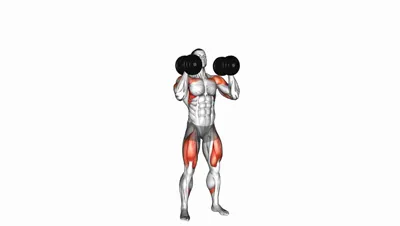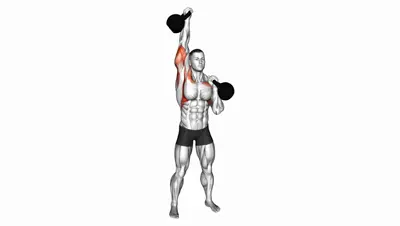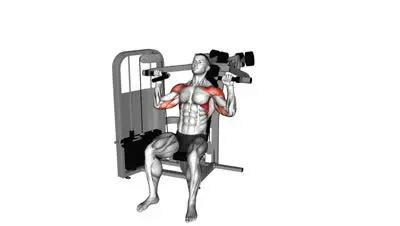

Description
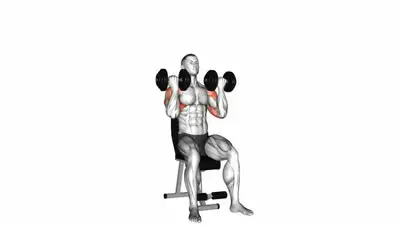
The cable shoulder press is a vertical pressing movement performed from low cable pulleys, training the front and lateral delts and triceps under constant tension. Whether seated or standing, you press two handles overhead against a cable line that keeps resistance on the delts through the entire range — including the top, where a barbell or dumbbell unloads at lockout. The smooth, continuous resistance curve is easier on the shoulder joint than a heavy free-weight press, while still building pressing strength and delt size. It is an excellent shoulder hypertrophy option and a joint-friendly alternative when overhead barbell work bothers your shoulders.
How to perform
- Set the pulleys low Set both cable pulleys to the lowest position. Sit on an upright bench placed between them, or stand in a staggered stance, and take a handle in each hand.
- Bring handles to shoulder height Bring the handles up to shoulder height with your palms facing forward, elbows bent and pointing down and slightly forward. The cables should already be loading the delts.
- Brace your core Take a breath, brace your core and squeeze your glutes (especially standing) so your lower back stays neutral under the overhead load.
- Press the handles overhead Press the handles up and slightly together until your arms are extended overhead, finishing with the hands near each other above your head. Keep the cables tracking smoothly.
- Lower with control Lower the handles back to shoulder height under control, keeping constant tension on the delts and resisting the cables on the way down.
- Keep tension between reps Do not let the stack settle at the bottom — keep the shoulders loaded and start each rep from a controlled shoulder-height position.
Tips
- Use the constant tension at lockout — squeeze the delts hard at the top where a barbell or dumbbell would normally rest.
- Press the handles slightly together overhead to follow the cable's natural arc and add a peak contraction.
- Squeeze your glutes and brace hard when pressing standing — the standing version turns it into a core stability exercise too.
- Choose this press when barbell or dumbbell overhead work irritates your shoulders; the guided cable line is usually more forgiving.
- Control the eccentric — resisting the cables on the way down doubles the time the delts spend under tension.
Common mistakes
- Hyperextending the lower back — leaning back to drive the handles up turns the press into an incline movement. Brace and squeeze the glutes.
- Letting the stack rest at the bottom — releasing tension between reps removes the constant-tension advantage of cables.
- Pressing the handles straight up and apart — failing to converge slightly wastes the cable's peak-contraction arc.
- Flaring the elbows behind the body — driving the elbows too far back stresses the shoulder; keep them slightly forward of the torso.
- Going too heavy — a load you can only move by leaning or using leg drive takes the work off the delts.
Recommended sets & reps
| Sets | Reps | RIR | |
|---|---|---|---|
| Strength | 3–4 | 6–8 | 1–2 |
| Hypertrophy | 2–3 | 8–12 | 1–2 |
| Endurance | 2–3 | 12–15 | 2–3 |
| Power | 3–4 | 5–6 | 1–2 |
These ranges are working sets only — add 1–2 progressive warm-up sets before each working set. Pair with 2× per week frequency to reach ~10–20 weekly sets for the shoulders, the volume range supported by current evidence (Schoenfeld 2017, Pelland 2025).
Benefits
Builds the front and lateral delts with constant tension that stays on the muscle through the entire range, including lockout where free weights unload. The smooth cable resistance curve is gentler on the shoulder joint than a heavy barbell, making it a reliable pressing option for lifters managing shoulder sensitivity. It still develops real pressing strength and delt size, and the converging cable arc allows a peak contraction overhead. Performed standing, it adds core and glute bracing demand; seated, it isolates the shoulders for focused hypertrophy. Easy to load in small increments, it is an excellent primary or accessory shoulder press for any program.
Frequently asked questions
Cable shoulder press vs barbell overhead press — which is better?
The barbell overhead press builds more raw pressing strength and full-body bracing; the cable press keeps constant tension on the delts, is easier on the shoulder joint, and allows a peak contraction at lockout. Use the barbell press for strength and the cable press for tension-focused hypertrophy or when overhead barbell work bothers your shoulders.
Should I do the cable shoulder press seated or standing?
Seated isolates the shoulders and lets you focus purely on the delts; standing adds significant core and glute bracing and more functional carryover. Beginners and those chasing pure shoulder hypertrophy should start seated; add the standing version once your bracing is solid.
Is the cable shoulder press good if I have shoulder pain?
It is often more shoulder-friendly than a barbell because the cable guides a smooth resistance curve and you can adjust the path. That said, press only through a pain-free range and see a professional if pain persists — no exercise should be trained through joint pain.
How often should I press overhead?
Train the shoulders about 2× per week. Include an overhead press in at least one session and lateral raises in the other to reach 10–20 weekly sets across the delts without overloading the pressing pattern.
Educational guidance only — not a substitute for in-person coaching. Train within your ability and use a spotter for heavy attempts.