
Description
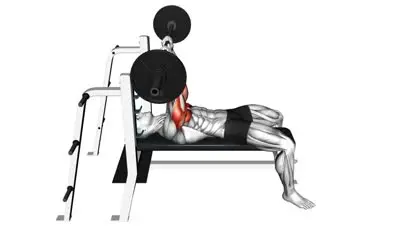
The close grip bench press narrows your hands to roughly shoulder width, keeping the elbows tucked along the torso and turning the bench press into the heaviest triceps exercise in the gym. The narrower grip lengthens the bar path and shifts much of the work from the chest to the triceps and front delts — which is why it is the standard assistance lift for a stronger bench press lockout. Contrary to the name, the hands do not touch: a grip narrower than shoulder width strains the wrists and elbows without adding triceps benefit. Heavy pressing loads plus direct triceps overload make it a rare two-for-one.
How to perform
- Lie down and set your base Set up exactly like a regular bench press — shoulder blades pulled down and back, feet planted, slight arch, eyes under the bar.
- Grip at shoulder width Place your hands roughly shoulder-width apart, not closer. Wrists stay stacked directly over your forearms with the bar deep in the palm.
- Unrack and position the bar Press the bar off the hooks and bring it over your lower chest with arms extended, keeping your lats lightly engaged.
- Lower with elbows tucked Bring the bar down over two to three seconds to your lower chest, keeping your elbows tracking close along your torso rather than flaring out.
- Press and squeeze the triceps Drive the bar back up in a slight arc, consciously extending through the elbows — the triceps should finish the rep, not the bounce.
- Lock out under control Fully extend the elbows at the top without letting the shoulders roll forward, then begin the next rep from a stable, tight position.
Tips
- Shoulder width is the right 'close' — moving the hands closer than that stresses the wrists and elbows without any extra triceps activation.
- Keep your elbows brushing past your sides on every rep; the tuck is what makes this a triceps lift instead of a narrow chest press.
- Touch the bar lower on your chest than in a regular bench — near the base of the sternum — so the forearms stay vertical at the bottom.
- Expect around 10–15 percent less weight than your regular bench; chase smooth lockouts, not chest-press numbers.
- If your wrists ache, check that the bar sits deep in your palms with knuckles up — a bar resting on bent-back wrists hurts regardless of grip width.
Common mistakes
- Gripping too narrow — hands inside shoulder width twist the wrists inward and grind the elbows without improving triceps work; shoulder width is the correct close grip.
- Letting the elbows flare halfway up — flaring recruits the chest to rescue the rep and abandons the triceps emphasis; tuck the elbows from touch to lockout.
- Bouncing the bar off the sternum — the longer bar path tempts a rebound, but it skips the hardest triceps range; pause lightly and press from a dead touch.
- Cutting the lockout short — stopping shy of full extension removes the very range the triceps own; finish every rep with straight elbows.
- Turning it into a max-ego lift — the close grip bench builds the lockout best in the 6–10 rep range with clean form, not with grinding singles that break elbow tuck.
Recommended sets & reps
| Sets | Reps | RIR | |
|---|---|---|---|
| Strength | 3–4 | 4–6 | 1–2 |
| Hypertrophy | 2–3 | 6–10 | 1–2 |
| Endurance | 2–3 | 12–15 | 2–3 |
| Power | 3–4 | 3–5 | 1–2 |
These ranges are working sets only — add 1–2 progressive warm-up sets before each working set. Pair with 2× per week frequency to reach ~10–20 weekly sets per muscle group, the volume range supported by current evidence (Schoenfeld 2017, Pelland 2025).
Benefits
Loads the triceps with more weight than any isolation exercise can, because the pressing pattern lets the chest and front delts assist while the elbows still do the decisive work. Directly strengthens the bench press lockout — the portion of the press where most attempts fail — which is why it is a staple assistance lift in powerlifting programs. Builds all three triceps heads under heavy compound load, adding the arm mass that pushdowns and extensions alone struggle to produce. Doubles as a joint-friendlier pressing option for many lifters, since the tucked elbows and shoulder-width grip keep the shoulders in a more neutral, stable position than wide-grip pressing.
Frequently asked questions
How close should my hands actually be?
Shoulder width — roughly where your palms would naturally land if you pressed straight up. Grips narrower than that strain the wrists and elbows without activating the triceps any harder.
Is the close grip bench press a chest or triceps exercise?
Both, with the emphasis shifted toward the triceps. The chest and front delts still contribute heavily, which is exactly why you can overload the triceps with far more weight than isolation work allows.
Will close grip pressing improve my regular bench press?
Yes — it targets the lockout portion where most bench attempts fail, and the carryover is well established in powerlifting practice. Program it as your second pressing movement at 6–10 reps.
How much weight should I use compared to my regular bench?
Most lifters press about 10–15 percent less with a close grip. If the gap is much bigger, your triceps are a weak link — which is precisely the argument for keeping this lift in your program.
Educational guidance only — not a substitute for in-person coaching. Train within your ability and use a spotter for heavy attempts.