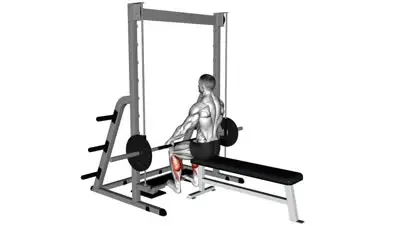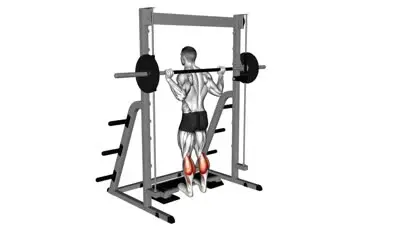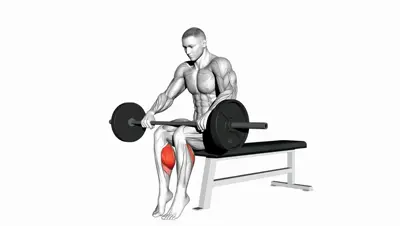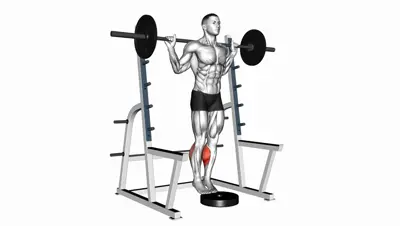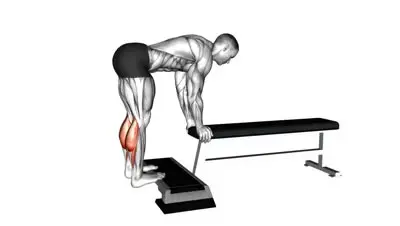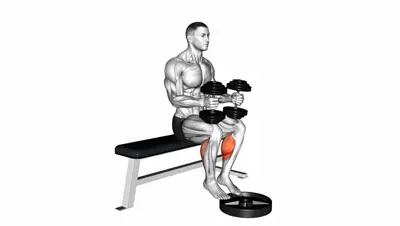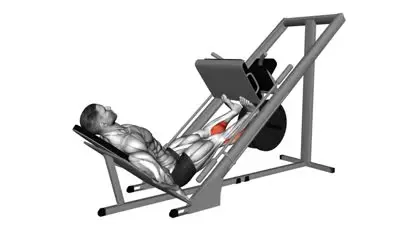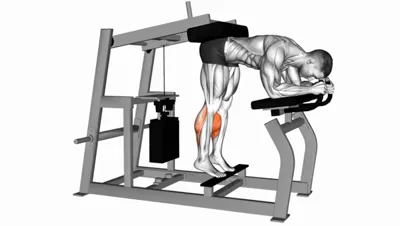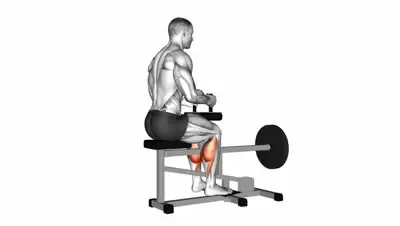

Description
The dumbbell calf raise is the simplest loaded calf exercise: one dumbbell held at your side, the balls of your feet on an edge, and a full stretch-to-squeeze range that most machine users never see. Holding the weight on the same side as the working leg — one leg at a time — turns it into strict unilateral training that exposes which calf actually does the work. Because the calves handle bodyweight all day, they respond to range and pause quality, not to bouncing: the deep stretch at the bottom and a genuine hold at the top decide whether this exercise builds muscle or just warms your ankles.
How to perform
- Set up on an edge Stand with the balls of your feet on a step or plate, heels hanging free. Hold a dumbbell on the working side and steady yourself with the other hand.
- Shift to one leg Lift the non-working foot and hook it behind the working ankle, keeping your standing knee straight but not slammed into lockout.
- Lower into a deep stretch Let the heel sink below the edge over two to three seconds until you feel a strong stretch through the calf and Achilles.
- Pause in the stretch Hold the bottom for one full second without bouncing — this dead stop removes the rebound that usually does the calf's work.
- Drive up onto your toes Press through the ball of the foot as high as you can rise, keeping the ankle rolling straight over the second toe rather than outward.
- Squeeze the top, then repeat Hold the top contraction for one to two seconds, then lower back into the stretch. Finish the set and switch legs with the dumbbell in the other hand.
Tips
- Hold the dumbbell on the same side as the working leg — it loads the calf directly and leaves the other hand free to balance, which keeps the reps honest.
- Make the pauses non-negotiable: one second dead in the stretch, one to two at the top; calves grow from controlled extremes, not from the bouncy middle.
- Keep the knee straight throughout to bias the gastrocnemius — this standing version and a seated, bent-knee raise together cover the whole calf.
- Rise onto the ball of the foot with the ankle tracking straight — rolling outward onto the pinky-toe side is both weaker and harder on the ankle.
- Progress the dumbbell slowly and protect the range: a heavier weight with a shrinking stretch is a net loss for growth.
Common mistakes
- Bouncing out of the bottom — the Achilles tendon happily springs the weight up if you let it, stealing the workload from the muscle; pause dead in the stretch every rep.
- Cutting the range at both ends — shallow dips in the middle third keep the calf semi-shortened forever; sink below the edge fully and rise all the way onto the toes.
- Bending the knee to press the weight up — knee extension adds quads to a calf exercise; the knee angle is set once and never changes mid-rep.
- Loading heavier than your balance allows — wobbling reps shorten the range and shift focus to staying upright; hold something stable and let the calf, not the balance, be the limiter.
- Rushing through high-rep sets — fast partial pumping feels productive but skips both pause positions; fifteen slow full reps beat thirty bounces.
Recommended sets & reps
| Sets | Reps | RIR | |
|---|---|---|---|
| Strength | 3–4 | 8–10 | 1–2 |
| Hypertrophy | 3–4 | 10–15 | 1–2 |
| Endurance | 2–3 | 15–25 | 2–3 |
| Power | 3 | 8–10 | 2–3 |
Reps count per leg. Calves tolerate high frequency and volume well — these working sets can run 2–3× per week within ~12–20 weekly calf sets, always with the full stretch-pause-squeeze standard rather than bounced partials (Schoenfeld 2017, Pelland 2025).
Benefits
Trains each calf independently with nothing but a dumbbell and a step, making it the most accessible serious calf exercise for home and hotel training alike. The unilateral loading reveals and corrects left-right calf differences that two-legged machine raises quietly preserve. The free-standing setup forces the ankle stabilizers to work with every rep, building ankle control that carries over to running, jumping and single-leg sports actions. Full stretch-to-squeeze range with strict pauses loads the gastrocnemius at long muscle lengths — the position research keeps flagging as the growth-relevant one — better than the bounced partial reps most lifters default to on machines.
Frequently asked questions
One leg or both legs — which version should I do?
Single-leg with the dumbbell on the working side is the stricter default: it doubles the effective load per calf and exposes asymmetries. Use the two-legged version with dumbbells in both hands when you want heavier total loads or are still building balance.
Why are my calves not growing from calf raises?
Usually range and tempo — bounced partials let the Achilles spring do the work. Sink into a full one-second stretch, squeeze the top for two, add reps before weight, and give it 2–3 sessions weekly; calves respond to patient, strict volume.
Do I really need a step or plate under my toes?
Yes — from flat ground you lose the below-neutral stretch, which is the most growth-relevant part of the range. Any stable edge of a few centimeters works: a plate, a step, a curb.
Straight knee or bent knee for calf raises?
Straight-knee versions like this one bias the gastrocnemius, the visible upper calf; bent-knee seated raises shift work to the deeper soleus. For complete calf development, program both across your week.
Educational guidance only — not a substitute for in-person coaching. Train within your ability and use a spotter for heavy attempts.