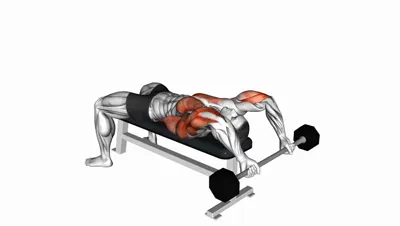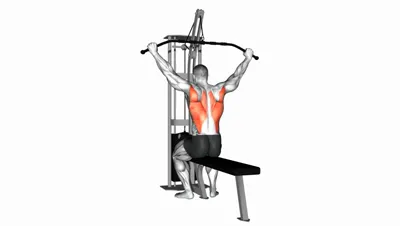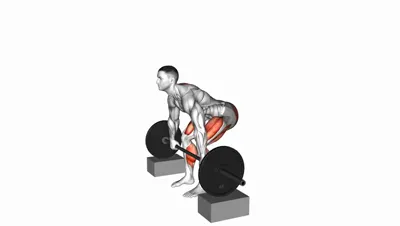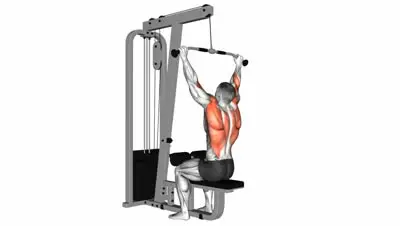

Description
The single-arm dumbbell row is a unilateral horizontal pull that builds back thickness one side at a time. Bracing one hand and knee on a bench, you row a dumbbell from a full stretch to your hip, training the lats, mid-traps, rhomboids and rear delts through a longer range of motion than a fixed barbell allows. Because each side works independently, it exposes and corrects left-right imbalances, while the bench support removes the lower back as a limiting factor — letting you chase heavy, clean back volume without the spinal fatigue of a bent-over barbell row.
How to perform
- Brace on the bench Place one knee and the same-side hand on a flat bench so your torso is roughly parallel to the floor with a flat back. Set a dumbbell on the floor within reach of your free hand.
- Set your lat before pulling Grab the dumbbell with a neutral grip and let it hang at arm's length. Pull your shoulder blade down and back to engage the lat, keeping your spine neutral and both hips square to the floor.
- Drive the elbow to your hip Row the dumbbell up by driving your elbow back toward your hip, leading with the elbow rather than the hand. Keep the upper arm close to your torso and squeeze the lat at the top.
- Lower to a full stretch Lower the dumbbell under control until the arm is straight and the lat is fully stretched, letting the shoulder reach slightly forward without rotating your torso.
- Resist trunk rotation Keep your hips and shoulders level for every rep — do not twist the torso to heave the weight. The braced side stays still and rigid.
- Match both sides Finish all reps on one side, then switch. Train the weaker side first and hold the stronger side to the same clean rep count.
Tips
- Lead with your elbow, not your hand — thinking 'elbow to hip pocket' recruits the lat far better than squeezing the dumbbell.
- Let the dumbbell pull your shoulder into a full stretch at the bottom of every rep — the lengthened position is where back growth happens.
- Keep your working-side hip and shoulder level; the instant you rotate to lift, the obliques take over and the lat disengages.
- Brace solidly against a sturdy bench so you can load heavy without your lower back stabilizing the whole movement.
- Use lifting straps on your heaviest sets so grip never cuts a back-building set short.
Common mistakes
- Twisting the torso to lift — rotating the trunk turns the row into an oblique swing and steals tension from the lat. Keep hips and shoulders square.
- Cutting the bottom short — stopping before a full stretch removes the lengthened-position tension that drives lat hypertrophy.
- Yanking with the biceps — pulling with the hand and arm instead of driving the elbow back makes it an arm exercise, not a back exercise.
- Shrugging the dumbbell up — letting the upper trap dominate at the top means the lats and rhomboids never finish the rep.
- Mismatched sides — doing more clean reps on the stronger side widens the very imbalance the unilateral row is meant to fix.
Recommended sets & reps
| Sets | Reps | RIR | |
|---|---|---|---|
| Strength | 3–4 | 6–8 | 1–2 |
| Hypertrophy | 2–3 | 8–12 | 1–2 |
| Endurance | 2–3 | 12–15 | 2–3 |
| Power | 3–4 | 4–6 | 1–2 |
These ranges are working sets per side — add 1–2 progressive warm-up sets before your first working set. Pair with 2× per week frequency to reach ~10–20 weekly sets for the back, the volume range supported by current evidence (Schoenfeld 2017, Pelland 2025).
Benefits
Builds back thickness one side at a time, exposing and correcting the left-right imbalances that bilateral barbell rows hide. The bench support removes the lower back as a limiting factor, so you can train the lats with heavy, high-quality volume without the spinal fatigue of a bent-over barbell row. The independent dumbbell path gives a longer range of motion and a deeper stretch at the bottom than a fixed bar allows, maximizing the lengthened-position tension linked to hypertrophy. It also strengthens the rear delts, rhomboids and grip as synergists, and trains the core to resist rotation. A staple back accessory that scales for years with simple dumbbell progression.
Frequently asked questions
Single-arm dumbbell row vs barbell row — which is better?
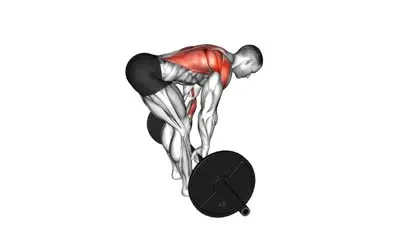
They complement each other. The barbell bent-over row moves more total load and builds bracing strength; the single-arm dumbbell row gives a longer range of motion, corrects side-to-side imbalances, and spares the lower back. Most lifters use the barbell row as a primary pull and the single-arm dumbbell row as an accessory.
How heavy should I go on single-arm dumbbell rows?
Heavy enough that the last rep is 1–2 reps shy of failure with strict form and no torso twist. For most lifters that means a dumbbell you can row for 8–12 clean reps per side. Add weight once you hit the top of your rep range on both sides.
Is the single-arm dumbbell row good for beginners?
Yes — the bench support makes it one of the most beginner-friendly back exercises because it removes the balance and lower-back demand of a free bent-over row. Start light, learn to lead with the elbow, and keep the torso still.
How often should I do rows?
Train your back, including rows, about 2× per week to accumulate 10–20 weekly sets. Rotate the single-arm dumbbell row with barbell or cable rows across sessions so the same pattern is trained from different angles.
Educational guidance only — not a substitute for in-person coaching. Train within your ability and use a spotter for heavy attempts.