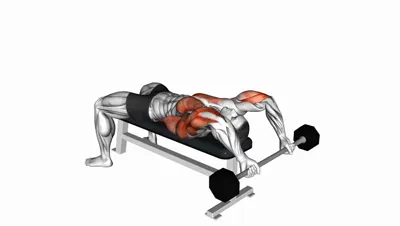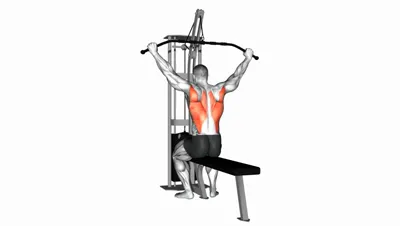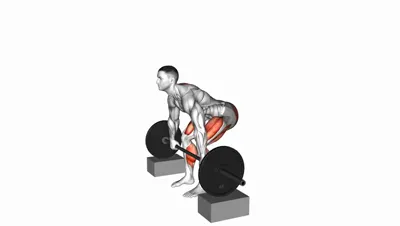

Description
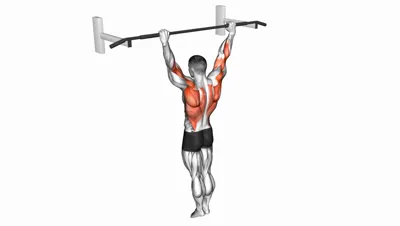
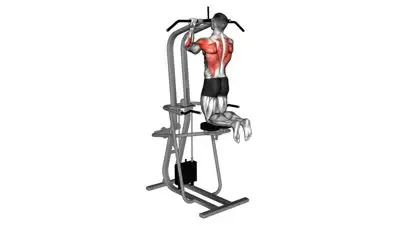
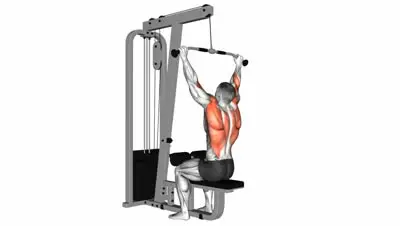
The V-bar lat pulldown is a vertical-pull machine variation that uses a close neutral grip to bias the lower lats and biceps. Sitting with your thighs anchored under a pad, you pull a V-shaped handle to your upper chest against scalable cable resistance. The neutral, palms-facing grip lets your elbows travel further down and tighter to the body than a wide overhand bar, increasing elbow flexion and the stretch on the lats at the top. With constant cable tension throughout, it is an excellent way to add lat thickness and pulling volume that complements wide-grip pulldowns and pull-ups.
How to perform
- Attach the V-bar handle Clip a close neutral V-bar handle to the pulldown cable and set the thigh pad so your legs are anchored snugly. Grip the handle with palms facing each other and sit with your arms fully extended overhead.
- Set a fixed torso angle Sit tall with a slight backward lean of about 10–20° from vertical and your chest up. Hold this torso angle for the whole set rather than rocking back and forth.
- Depress the shoulder blades Before bending the elbows, pull your shoulder blades down and back. This pre-tension keeps the pull lat-driven instead of biceps-dominant.
- Pull the handle to your chest Drive your elbows straight down and slightly back, pulling the V-bar to your upper chest. The neutral grip lets the elbows travel deeper than a wide bar — use that extra range.
- Squeeze the lower lats Pause briefly with the handle near your sternum and the lats fully contracted. Keep tension on the muscle rather than collapsing the chest into the bar.
- Control the stretch back up Let the handle rise under control to full overhead extension, allowing the lats to stretch without shrugging the shoulders up. Do not let the stack slam between reps.
Tips
- Use the extra elbow range the neutral grip allows — pull the handle all the way to the sternum, not just to the collarbone.
- Lead with the elbows driving toward your back pockets; the V-bar makes it easy to let the biceps take over if you pull with the hands.
- Reach a full overhead stretch each rep — the lengthened top position is where the lower-lat fibres do their work.
- Keep the torso angle fixed — rocking back to move a heavier stack turns the pulldown into a seated row.
- Slow the eccentric to 2–3 seconds under constant cable tension instead of letting the stack drop.
Common mistakes
- Using momentum — leaning way back and swinging the torso to move a heavy stack trains the hips and lower back, not the lats.
- Stopping short at the top — cutting the overhead stretch short removes the lengthened-position tension that drives lat growth.
- Letting the biceps dominate — pulling with the hands instead of depressing the shoulder blades first turns the V-bar pulldown into a curl.
- Pulling only to the collarbone — wasting the deeper elbow range the neutral grip provides limits lower-lat involvement.
- Going too heavy — a stack you can only move by heaving means the lats never actually do the work. Drop the weight and own the form.
Recommended sets & reps
| Sets | Reps | RIR | |
|---|---|---|---|
| Strength | 3–4 | 6–8 | 1–2 |
| Hypertrophy | 2–3 | 8–12 | 1–2 |
| Endurance | 2–3 | 12–20 | 2–3 |
| Power | 3–4 | 5–6 | 1–2 |
These ranges are working sets only — add 1–2 progressive warm-up sets before each working set. Pair with 2× per week frequency to reach ~10–20 weekly sets for the back, the volume range supported by current evidence (Schoenfeld 2017, Pelland 2025).
Benefits
Adds lat thickness and a wide back with the precise, scalable resistance of a cable stack. The close neutral grip increases elbow flexion and biases the lower lats and biceps, complementing the upper-lat emphasis of a wide-grip pulldown or pull-up. Constant cable tension keeps the muscle loaded through the entire range, and the fixed seat removes the bracing demand of a free pull so you can focus purely on contracting the back. It lets you dial load in small increments for clean week-to-week progressive overload, and the neutral grip is easier on the wrists and elbows than a pronated bar — making it a joint-friendly way to bank high-quality back volume.
Frequently asked questions
V-bar pulldown vs wide-grip lat pulldown — what's the difference?
The wide overhand pulldown biases the upper lats and teres major; the V-bar's close neutral grip increases elbow flexion and shifts emphasis to the lower lats and biceps with a longer range of motion. They are complementary — rotating both over a training block trains the back from two angles.
What can I do if my gym has no V-bar attachment?
Use any close neutral-grip handle on the pulldown cable, or a close-grip row handle clipped to the high pulley. A neutral-grip pull-up trains the same pattern with bodyweight. The key feature is the palms-facing close grip, not the specific V-bar shape.
How do I progress the V-bar pulldown?
Add a small increment to the stack once you hit the top of your rep range with strict form, or slow the eccentric and add a peak-contraction pause. Because the stack moves in small steps, it is one of the easiest back exercises to overload precisely week to week.
How often should I train vertical pulls?
About 2× per week is enough to build the lats while recovering. Pair the V-bar pulldown with pull-ups or wide-grip pulldowns across your weekly sessions to cover the full vertical-pull pattern without overusing one grip.
Educational guidance only — not a substitute for in-person coaching. Train within your ability and use a spotter for heavy attempts.