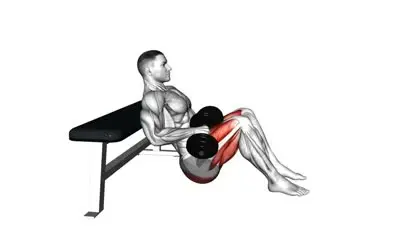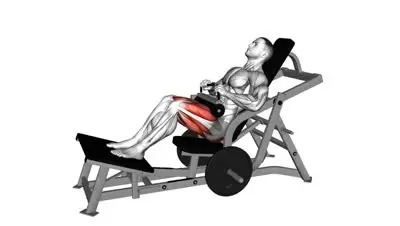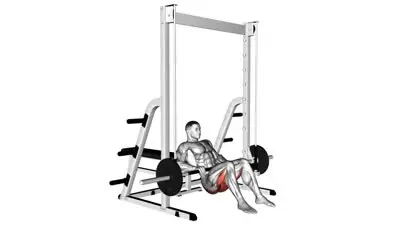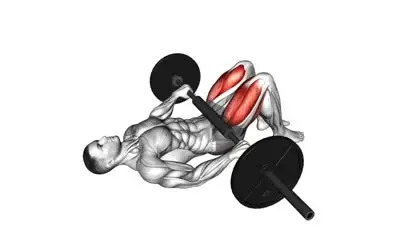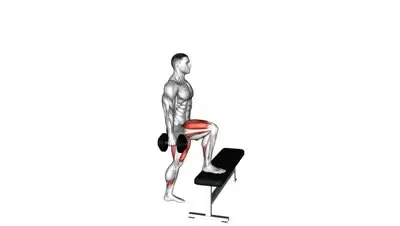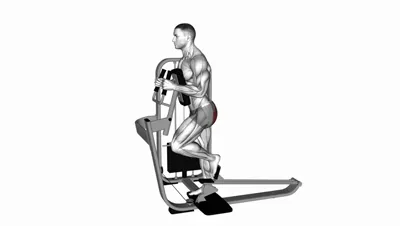

Description
The barbell hip thrust is the most direct way to load the glutes through their strongest range — full hip extension under heavy weight. With your upper back braced on a bench and the bar across your hips, you drive the hips upward until the torso is level, placing peak tension exactly where the glutes contract hardest. Popularized by glute-focused training research over the last decade, it allows heavier loading than almost any other glute exercise while keeping spinal stress low, which makes it the cornerstone of modern glute hypertrophy and sprint-performance programs.
How to perform
- Set your back on the bench Sit on the floor with your upper back against a sturdy bench, the bench edge sitting just under your shoulder blades. Roll a padded barbell over your hips.
- Plant your feet hip-width Place your feet flat, hip-to-shoulder-width apart, close enough that your shins will be vertical at the top of the rep.
- Brace and tuck your chin Brace your core, tuck your chin slightly and keep your ribs down — your torso should move as one rigid unit, not arch segment by segment.
- Drive your hips to the ceiling Push through your heels and drive the hips straight up until your thighs and torso form a flat tabletop, knees bent about 90 degrees.
- Squeeze hard at lockout At the top, posteriorly tilt the pelvis — think tucking your tailbone — and squeeze the glutes for a full second without hyperextending the lower back.
- Lower with control and repeat Lower the hips a controlled few inches to a soft touch of the floor or just above it, keeping tension in the glutes before the next drive.
Tips
- Use a thick bar pad or folded mat — hip comfort is the first limiter most lifters hit, long before glute strength.
- Check your foot distance with a top-position rehearsal: shins vertical at lockout puts the glutes, not the quads or hamstrings, in charge.
- Keep your chin tucked and eyes forward through the whole rep — letting the head fall back invites lower-back hyperextension.
- Think 'ribs down, tailbone tucked' at the top; the squeeze should be felt in the glutes, never as pinching in the lumbar spine.
- Push through your whole foot with emphasis on the heels — if your calves cramp, the load has drifted onto your toes.
Common mistakes
- Hyperextending the lower back at the top — arching past neutral shifts load from glutes to lumbar spine; finish with a posterior pelvic tilt instead.
- Setting the feet too far forward — this turns the movement into a hamstring bridge and reduces glute tension at lockout; keep shins vertical at the top.
- Cutting the range short — stopping below a flat tabletop position skips the peak-contraction zone where the hip thrust earns its reputation.
- Throwing the head back to grind reps — the neck whip drags the spine into extension and signals the weight is too heavy for clean lockouts.
- Bouncing the weight off the floor — dropping and ricocheting between reps removes the controlled eccentric and beats up the hip crease under the bar.
Recommended sets & reps
| Sets | Reps | RIR | |
|---|---|---|---|
| Strength | 3–4 | 5–8 | 1–2 |
| Hypertrophy | 2–3 | 8–12 | 1–2 |
| Endurance | 2–3 | 12–20 | 2–3 |
| Power | 3–4 | 3–5 | 1–2 |
These ranges are working sets only — add 1–2 progressive warm-up sets before each working set. Pair with 2× per week frequency to reach ~10–20 weekly sets per muscle group, the volume range supported by current evidence (Schoenfeld 2017, Pelland 2025).
Benefits
Delivers the highest direct glute tension of any common gym lift, with peak load at full hip extension — the zone squats and deadlifts barely train. Tolerates heavy progressive overload safely because the bench and floor support the spine, letting glute strength, size and hip power climb for years. Strong hip extension transfers directly to sprint speed, jumping and deadlift lockout strength. Builds the hamstrings as synergists while teaching the pelvis control that protects the lower back in every other lift. Easy to scale: the same pattern works with a barbell, a single dumbbell or bodyweight, making it accessible at every experience level.
Frequently asked questions
Why don't I feel hip thrusts in my glutes?
The usual culprits are feet placed too far forward, range cut short of full lockout, or no pelvic tilt at the top. Re-set so your shins are vertical at lockout, pause for a hard one-second squeeze with the tailbone tucked, and the glutes will take over.
Hip thrust vs squat — which builds glutes better?
Both grow the glutes; they load different parts of the range. The hip thrust peaks tension at full hip extension while the squat stresses the stretched position. Programs that include both cover the complete strength curve — if glutes are your priority, the hip thrust is the more direct tool.
How heavy should I go on barbell hip thrusts?
The glutes handle heavy loads well — many lifters work up to bodyweight on the bar and beyond within months. Progress only as long as you can hold a one-second lockout squeeze without lumbar arching; when lockouts get shaky, the weight is ahead of your control.
What bench height should I use for hip thrusts?
A standard 40–45 cm / 16–18 inch bench suits most bodies, with the edge contacting just below the shoulder blades. If you are shorter, a slightly lower surface or a plate under your feet restores the flat tabletop top position.
Educational guidance only — not a substitute for in-person coaching. Train within your ability and use a spotter for heavy attempts.