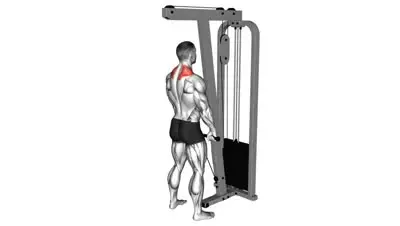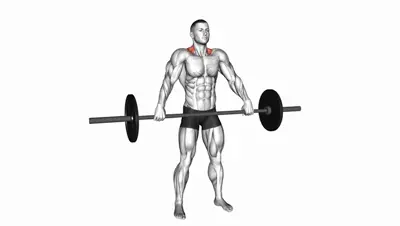

Description
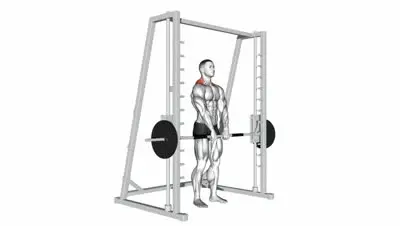
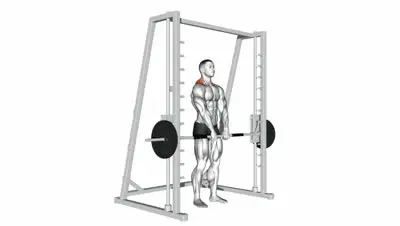
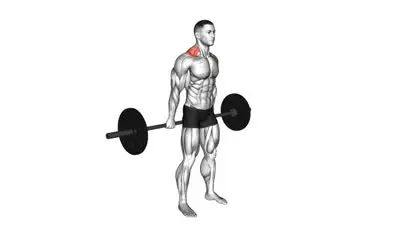
The barbell shrug is the most direct way to overload the upper traps: you hold a heavy bar at arm's length and elevate your shoulders straight up toward your ears, nothing more. Because the range of motion is short and the traps are strong, the barbell lets you load this movement heavier than any other trap exercise — but the same short range makes it easy to cheat with bounces and half reps. The often-repeated advice to roll the shoulders is a myth worth ignoring: the traps elevate the shoulder girdle vertically, and rolling only adds shoulder wear without extra stimulus.
How to perform
- Deadlift the bar into position Stand with the bar over mid-foot, hinge down with a flat back, grip just outside your thighs and stand tall so the bar hangs at arm's length.
- Set your posture and brace Stand upright with your chest tall, core braced and knees very slightly bent. Your arms stay straight — they are hooks, not lifters.
- Shrug straight up Drive your shoulders vertically toward your ears as high as they will go, keeping the bar close to your body and your head neutral.
- Hold the top squeeze Pause for one to two seconds at the highest point and squeeze the traps hard — this top hold is where most of the value lives.
- Lower to a full stretch Let your shoulders travel all the way down over two to three seconds until you feel a clear stretch in the upper traps at the bottom.
- Reset and repeat Re-brace your core briefly, then begin the next rep from the dead-hang stretch without bouncing or dipping your knees for momentum.
Tips
- Shrug straight up and down — the traps elevate the shoulders vertically, and rolling them forward or backward adds joint stress without any extra muscle work.
- Treat the top pause as the rep's purpose: one to two full seconds of hard squeeze separates trap training from bar bouncing.
- Use lifting straps once your grip limits the set — the traps can handle far more weight than your forearms can hold, and grip failure ends sets early.
- Let the bar pull you into a genuine stretch at the bottom of every rep; the lengthened position is half the stimulus and most lifters skip it entirely.
- Keep your chin neutral rather than jutting it forward — a packed neck keeps the traps working in line instead of straining the cervical spine.
Common mistakes
- Rolling the shoulders in circles — the rolling motion is a myth that adds nothing for the traps and grinds the shoulder joint; shrug vertically, pause, lower.
- Loading so heavy the range shrinks to a twitch — two-centimeter bounces with maximal weight train ego, not traps; pick a load that allows a full up-pause-down cycle.
- Bending the elbows to pull the bar higher — arm pull turns the shrug into a half-hearted upright row; arms stay straight the entire set.
- Dipping the knees to bounce each rep up — leg drive hides trap weakness and turns the set into momentum practice; if you need the bounce, the bar is too heavy.
- Skipping the bottom stretch — reversing direction at half depth keeps the traps permanently short; let the shoulders hang fully before each rep.
Recommended sets & reps
| Sets | Reps | RIR | |
|---|---|---|---|
| Strength | 3–4 | 6–8 | 1–2 |
| Hypertrophy | 3–4 | 8–12 | 1–2 |
| Endurance | 2–3 | 12–20 | 2–3 |
| Power | 3 | 6–8 | 2–3 |
These ranges are working sets only — add 1–2 progressive warm-up sets before each working set. The traps recover fast and also work in every deadlift and carry, so 2× per week of direct shrugging within ~10–20 total weekly sets is plenty (Schoenfeld 2017, Pelland 2025).
Benefits
Overloads the upper traps with more weight than any other exercise, because the short vertical range and straight-arm setup let you hold loads well beyond your rowing or pulling strength. Builds the thick neck-to-shoulder slope that visually anchors a developed upper body and is hard to achieve through indirect work alone. Strengthens the shoulder-elevation pattern that supports heavy deadlifts, farmer's carries and Olympic pull variations, where the traps stabilize tons of cumulative load. Doubles as productive grip training when done strapless — a heavy bar held for slow, paused shrug sets challenges the forearms almost as much as dedicated grip work.
Frequently asked questions
Should I roll my shoulders when shrugging?
No — the upper traps elevate the shoulder girdle straight up, so vertical shrugging matches their function exactly. Rolling adds shoulder joint stress and zero extra trap stimulus; the cue survives on gym folklore, not anatomy.
How heavy should I go on barbell shrugs?
As heavy as allows a full range with a one-to-two-second top pause — for most lifters that is somewhere around their deadlift warm-up weights. If the movement shrinks to a bounce, the bar has beaten you.
Are shrugs even necessary if I deadlift heavy?
Deadlifts give the traps hard isometric work, and some lifters grow well from that alone. If your upper traps lag visually despite heavy pulling, direct shrug volume is the logical, low-cost addition.
Barbell or dumbbell shrugs — which is better?
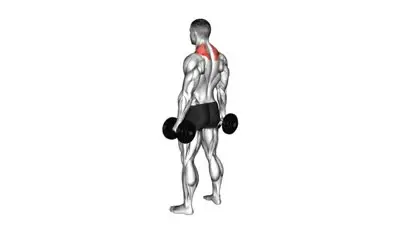
The barbell allows the heaviest loading; dumbbells at your sides allow a slightly longer range and a more natural hand position. Many lifters use the barbell for heavy work and dumbbells for higher-rep, fuller-range sets.
Educational guidance only — not a substitute for in-person coaching. Train within your ability and use a spotter for heavy attempts.