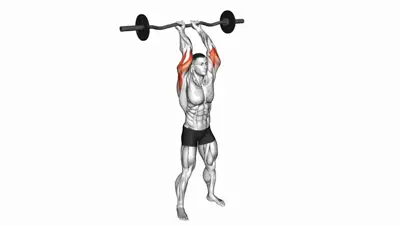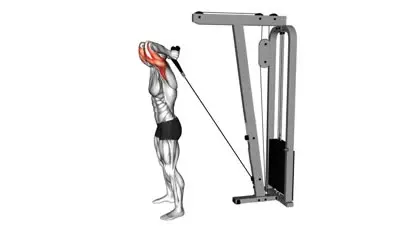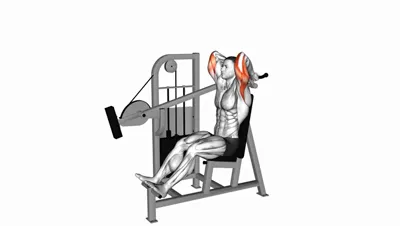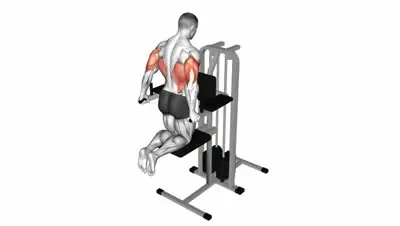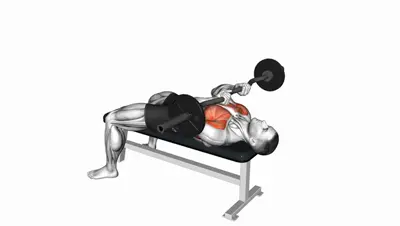

Description
The dumbbell overhead triceps extension trains the triceps where they grow best — at full stretch. Holding one dumbbell overhead with both hands, you lower it behind your head and extend back up, putting the long head of the triceps under deep, loaded stretch on every rep. The long head is the biggest of the three and crosses the shoulder joint, so it only reaches full length with the arms overhead — recent research shows overhead work grows it substantially faster than pushdowns. That makes this simple movement the highest-leverage triceps exercise most lifters are not doing.
How to perform
- Grip the dumbbell overhead Sit or stand tall and hold one dumbbell vertically overhead, both palms flat against the inside of the upper plate, thumbs around the handle.
- Set your elbows narrow Point your elbows forward-and-up beside your head, upper arms vertical — this is the position they hold all set.
- Lower behind your head Bend only the elbows and lower the dumbbell behind your head in two to three seconds until you feel a deep triceps stretch.
- Pause in the stretch Hold the deepest comfortable position for a brief beat without the elbows flaring outward or the back arching.
- Extend to just short of lockout Press the dumbbell back up by straightening the elbows, stopping just before a hard lockout to keep tension on the muscle.
- Stay tall between reps Keep your ribs down, core braced and neck neutral — the body is a pillar, only the forearms move.
Tips
- The stretch is the product: prioritize a deep, controlled descent over load, because the lengthened position is where the long head earns its growth.
- Keep the elbows pointing forward and tucked beside the head — the further they flare, the more the stretch leaks away.
- Brace your core and tuck your ribs as you press — an arching lower back is the body's favorite way to fake range it doesn't have.
- Seated with a backrest is the stricter version; standing demands more core control. Choose based on whether the triceps or your posture fails first.
- If your shoulders lack the mobility to hold the dumbbell straight overhead, work the same stretch with a cable from a low pulley instead of forcing the position.
Common mistakes
- Flaring the elbows wide — letting them wing outward turns the extension into a press, robs the stretch and crowds the shoulder joint.
- Arching the lower back to push the weight up — that extension comes from the spine, not the triceps; brace harder or take a lighter bell.
- Cutting the descent short — stopping at 90 degrees skips the deep stretch that is the entire reason to lift overhead in the first place.
- Hitting the head or neck on the way down — choosing a dumbbell too big or rushing the descent makes the path unsafe; control buys clearance.
- Bouncing out of the bottom — the stretched triceps tendon under rebound is an elbow complaint waiting to happen; pause, then press.
Recommended sets & reps
| Sets | Reps | RIR | |
|---|---|---|---|
| Strength | 3–4 | 8–10 | 1–2 |
| Hypertrophy | 3–4 | 10–15 | 1–2 |
| Endurance | 2–3 | 15–20 | 2–3 |
| Power | 3 | 8–10 | 2–3 |
These ranges are working sets only — add 1–2 progressive warm-up sets before each working set. Pair with 2× per week frequency to reach ~10–20 weekly sets per muscle group, the volume range supported by current evidence (Schoenfeld 2017, Pelland 2025).
Benefits
Trains the long head of the triceps at full stretch — the position overhead movements alone provide — and research comparing overhead extensions to pushdowns found meaningfully faster long-head growth when training overhead. Since the long head is the largest of the three heads, this is the fastest route to visibly bigger arms. The deep loaded stretch also builds elbow-friendly tendon resilience when progressed patiently. One dumbbell and a small space are all it takes, and the seated version turns it into one of the strictest isolation movements in the gym.
Frequently asked questions
Why train triceps overhead at all?
The long head crosses the shoulder, so it only reaches full stretch with the arm overhead — pushdowns never get it there. Overhead work loads that stretched position, and a 2022 training study found roughly 1.4× more triceps growth versus pushdowns at matched volume.
One dumbbell with both hands or one per hand?
The two-handed single dumbbell is the strongest and most stable default. Single-arm work doubles your set time but evens out side-to-side gaps and lets a tight shoulder choose a friendlier path. Build your base with the two-handed version and rotate in single-arm blocks.
Should I do these seated or standing?
Seated with a backrest is stricter — the pad stops the lower back from arching, so the triceps do all the work. Standing trains bracing alongside but invites rib flare under fatigue. If you feel overhead extensions in your lower back, sit down.
My elbows hurt on overhead extensions — what now?
Slow the eccentric, stop short of the very deepest stretch, and trim the load 20–30 % for a few weeks — the elbow usually complains about speed and rebound, not the movement itself. If pain persists despite strict tempo, swap to cable overhead extensions and reintroduce the dumbbell later.
Educational guidance only — not a substitute for in-person coaching. Train within your ability and use a spotter for heavy attempts.