
Description
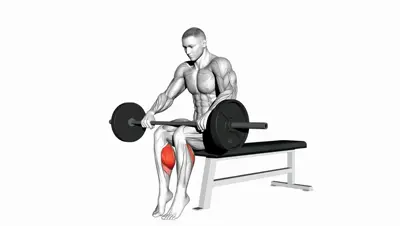
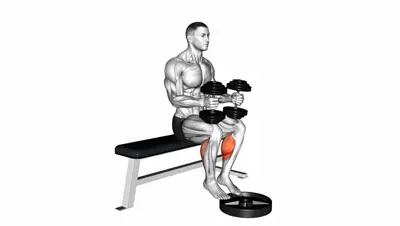
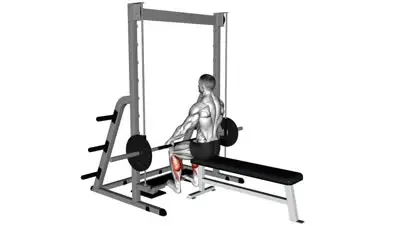
The smith seated calf raise is a soleus-focused calf isolation performed seated on a Smith machine. Sitting with a pad across your thighs and the balls of your feet on a platform, you raise your heels against the guided Smith bar. The bent-knee seated position takes the gastrocnemius out of the movement and places the work almost entirely on the soleus — the deeper, slower-twitch calf muscle responsible for most of the lower leg's mass and standing endurance. The Smith machine's fixed bar path removes balance from the equation, so you can load the soleus heavily and chase a full stretch and squeeze on every rep.
How to perform
- Set the seat and bar Sit on a bench inside a Smith machine and set the bar height so the thigh pad rests across your lower thighs when the balls of your feet are on a raised platform or block.
- Position the balls of your feet Place the balls of your feet on the platform with your heels free to drop below, knees bent about 90° under the bar pad.
- Unrack and find the stretch Rotate the Smith bar to unrack it, then let your heels drop below the platform until you feel a deep stretch in the calves.
- Raise the heels Press through the balls of your feet to raise your heels as high as possible, contracting the soleus fully at the top of the range.
- Pause and squeeze Pause briefly at the top with the calves fully contracted, then begin a slow descent. Do not bounce out of the bottom.
- Lower into a full stretch Lower the heels slowly back below the platform into a deep stretch, controlling the load the whole way. Reset and repeat with full range every rep.
Tips
- Use a full range every rep — drop the heels into a deep stretch at the bottom and press to a high contraction at the top.
- Pause at both ends: a beat in the stretched bottom and a hard squeeze at the top beat fast, bouncy partial reps for the soleus.
- Keep the reps controlled and slow; the calves respond to time under tension and a full range, not heaved momentum.
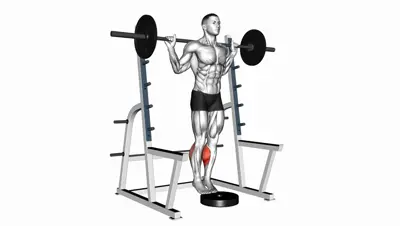
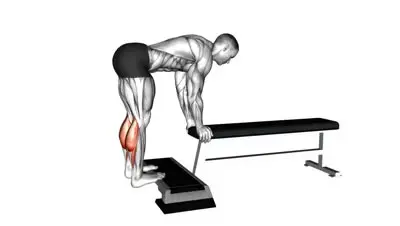
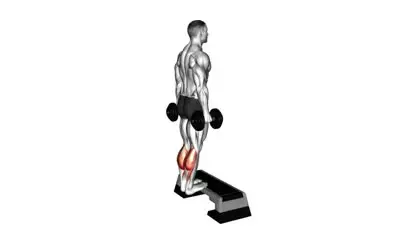
- Use the seated bent-knee position specifically to hit the soleus — pair it with a standing (straight-leg) raise to also train the gastrocnemius.
- Run higher reps on the soleus; as a slow-twitch, endurance-oriented muscle it tolerates and benefits from 12–25 reps.
Common mistakes
- Bouncing the bottom — using the stretch reflex to rebound out of the bottom removes tension and is the top reason calves do not grow.
- Partial range — short, choppy reps that skip the stretch and the top squeeze waste most of the calf's growth stimulus.
- Rushing the reps — fast tempo on a small muscle that thrives on time under tension severely limits the stimulus.
- Loading too heavy to use full range — piling on plates you can only half-rep trades effective range for ego weight.
- Letting the knees drift — the bent-knee position is what biases the soleus; standing up or straightening the knees changes the target muscle.
Recommended sets & reps
| Sets | Reps | RIR | |
|---|---|---|---|
| Strength | 3–4 | 8–10 | 1–2 |
| Hypertrophy | 3–4 | 10–15 | 1–2 |
| Endurance | 2–3 | 15–25 | 2–3 |
| Power | 3 | 8–10 | 2–3 |
The soleus is slow-twitch and endurance-oriented — favour 3–4 sets of higher reps (10–25) with a full stretch and a paused squeeze rather than heavy low-rep work. These are working sets only; pair with standing calf raises across the week for ~10–20 weekly calf sets (Schoenfeld 2017, Pelland 2025).
Benefits
Targets the soleus directly through the bent-knee seated position, which removes the gastrocnemius and loads the deeper calf muscle responsible for most of the lower leg's mass and standing endurance. The Smith machine's guided bar path removes balance from the lift, letting you load the soleus heavily and focus purely on a full stretch and a hard contraction. Training the soleus is what fills out the lower, wider portion of the calf that standing raises alone often miss. As a stable, low-skill isolation it is easy to push to failure with high reps and a controlled tempo. Paired with standing calf raises, it builds complete, fully developed calves.
Frequently asked questions
Seated vs standing calf raise — what's the difference?
The bent-knee seated calf raise targets the soleus (the deep calf muscle), while the straight-leg standing calf raise targets the gastrocnemius (the visible upper calf). Both make up the calf, so training both — seated for the soleus, standing for the gastrocnemius — is the key to complete lower-leg development.
Why use the Smith machine for seated calf raises?
The Smith machine's fixed bar path removes balance and stabilization from the lift, so you can load the soleus heavily and focus entirely on a full stretch and squeeze. If your gym has a dedicated seated calf machine, that works just as well — the Smith is a convenient substitute.
How many reps should I do for calves?
The soleus is slow-twitch and responds well to higher reps — 10–25 per set with a full range, a paused stretch and a hard squeeze. Heavy low-rep sets are less effective here. Chase controlled reps and a deep stretch rather than maximal load.
How often should I train calves?
Calves recover quickly and benefit from frequency — 2–3× per week is ideal. Spreading your weekly calf volume across several sessions, and rotating seated (soleus) with standing (gastrocnemius) work, builds the lower legs faster than one heavy session.
Educational guidance only — not a substitute for in-person coaching. Train within your ability and use a spotter for heavy attempts.