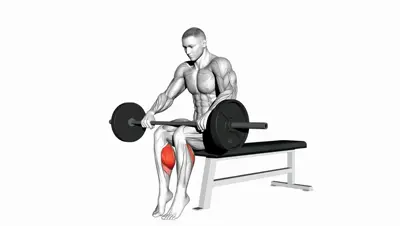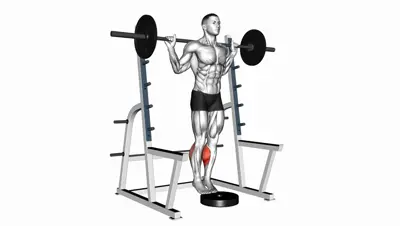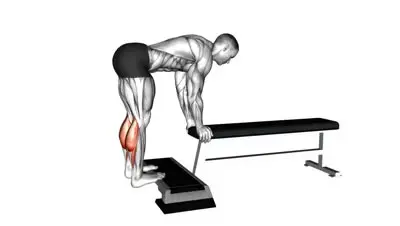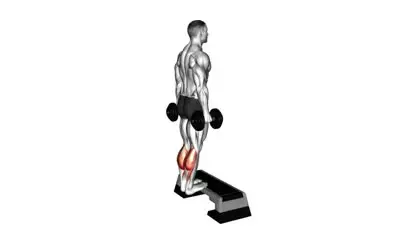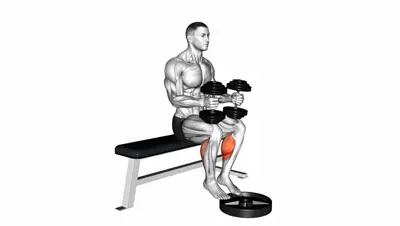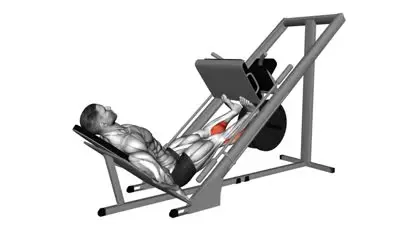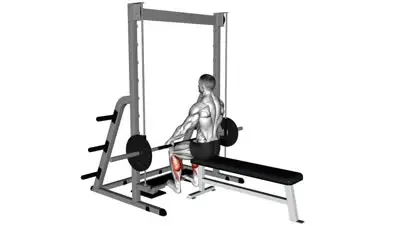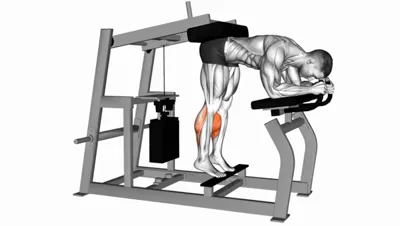

Description
The standing calf raise machine trains the gastrocnemius — the visible, diamond-shaped calf muscle — by loading heel raises with straight knees through a full stretch and contraction. Shoulder pads transfer the load down through a rigid torso while the balls of your feet work from a deep drop below the platform edge to full tip-toe height. Because the gastrocnemius only works hard when the knee is extended, the standing version is the cornerstone of calf training — the seated variant with bent knees shifts the work to the deeper soleus instead. Strict range and slow eccentrics decide everything here.
How to perform
- Set the pad height Adjust the shoulder pads so you must dip slightly to get under them and the machine lifts to full height as you stand.
- Place the balls of your feet Stand with the balls of your feet on the platform edge, feet hip-width and pointing forward, heels hanging free.
- Stand tall and unrack Extend your hips and knees to take the load, core braced, knees straight but never locked back hard.
- Lower into a deep stretch Lower your heels slowly below the platform edge until the calves reach a strong stretch — two to three seconds down.
- Pause in the bottom Hold the stretched position for a one-second count without bouncing — this dead stop removes the tendon's rebound.
- Drive to full tip-toe Press through the balls of your feet to rise as high as possible, squeezing the calves hard at the top before the next rep.
Tips
- The one-second pause at the bottom is the single biggest upgrade most lifters can make — it converts every rep from a tendon bounce into a muscle contraction.
- Aim for maximum height at the top, as if reaching your head toward the ceiling, and squeeze for a beat before lowering.
- Keep the knees straight throughout — a knee bend hands the work to the soleus and quads, which is the seated machine's job, not this one.
- The calves tolerate and need higher reps: most growth happens in the 10–20 range with full range, not in heavy quarter-rep grinders.
- Train calves first or fresh on leg day occasionally — they are usually trained last and tired, which is partly why they lag.
Common mistakes
- Bouncing out of the bottom — the Achilles tendon's elastic rebound does the lifting while the muscle coasts; pause at the stretch to make the calf work.
- Half-repping the top and bottom — short pulses in the middle of the range skip both the stretch and the peak contraction, the two zones that grow the calf.
- Bending the knees to push more weight — knee drive recruits the quads and soleus and inflates the number while the gastrocnemius gets robbed.
- Loading more than full range allows — if the heels cannot drop below the platform, the stack is too heavy for productive reps.
- Rushing the eccentric — dropping the heels fast wastes the lengthened-position tension the calves respond to most.
Recommended sets & reps
| Sets | Reps | RIR | |
|---|---|---|---|
| Strength | 3–4 | 8–10 | 1–2 |
| Hypertrophy | 3–4 | 10–15 | 1–2 |
| Endurance | 2–3 | 15–25 | 2–3 |
| Power | 3 | 8–10 | 2–3 |
These ranges are working sets only — add 1–2 progressive warm-up sets before each working set. Calves tolerate high frequency well; 2–3 sessions per week within ~10–20 weekly sets aligns with current volume evidence (Schoenfeld 2017, Pelland 2025).
Benefits
Directly targets the gastrocnemius, the muscle that gives the calf its visible shape and size, through the straight-knee position only standing variations provide. The deep loaded stretch below the platform is one of the strongest growth signals available for a muscle group famous for stubbornness. Builds ankle strength and stiffness that transfer to sprinting, jumping and the stability of every squat and deadlift you perform. The machine's guided path makes strict full-range reps easy to repeat and progress, and strong calves protect the Achilles tendon by preparing it for load gradually.
Frequently asked questions
Standing vs seated calf raise — what's the difference?
Knee angle decides the muscle. Standing with straight knees trains the gastrocnemius, the big visible calf; seated with bent knees shifts the work to the soleus underneath. They are complements, not substitutes — a complete calf program includes both.
Why won't my calves grow?
Almost always range and tempo: bounced quarter-reps let the Achilles tendon do the work elastically. Full heel-drop stretch, a one-second bottom pause, a hard top squeeze and 10–20 weekly sets done 2–3 times per week change the picture within months.
How many reps should I do for calves?
Mostly 10–15 strict reps for hypertrophy, with profitable sets up to 25 reps thanks to the calf's endurance-oriented fiber mix. Heavier sets of 8–10 have their place, but only with the same full range — heavy never excuses short.
Should my toes point in or out on calf raises?
Keep the feet straight ahead as the default — it loads both gastrocnemius heads evenly. Slight toe-out shifts a bit of emphasis to the inner head and toe-in to the outer, but the effect is small; full range and progression matter far more.
Educational guidance only — not a substitute for in-person coaching. Train within your ability and use a spotter for heavy attempts.