
Description
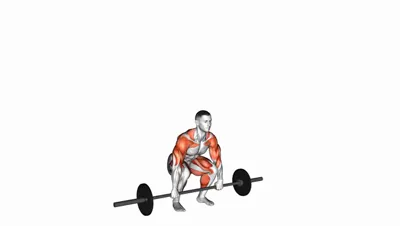
The sumo deadlift pulls from the floor with a wide stance and hands inside the knees, keeping the torso more upright than a conventional deadlift and shifting emphasis toward the glutes, adductors and quads. The wider base shortens the bar path and reduces the demand on the lower back, which is why many lifters with longer torsos or cranky spines pull better sumo. It is not a shortcut, though: the sumo setup is less forgiving of sloppy positioning, and reps only feel strong when the knees track over the toes and the tension is pulled out of the bar before it leaves the floor.
How to perform
- Take your wide stance Stand with feet well outside shoulder width, toes turned out about 30–45 degrees, shins vertical and the bar over mid-foot, almost touching your shins.
- Grip inside your knees Hinge down and grip the bar with straight arms inside your knees, hands about shoulder-width apart, using a double overhand or mixed grip.
- Wedge your hips into position Drop your hips, push your knees out over your toes and lift your chest until your back is flat and your shoulders sit just over the bar.
- Pull the slack out of the bar Take a big breath, brace hard and pull up on the bar until it clicks against the plates — build full-body tension before anything moves.
- Drive the floor apart Push your feet out and down as if spreading the floor, keeping the bar dragging up your legs and your chest rising with your hips.
- Lock out and return Finish tall by squeezing your glutes through — no lean-back — then push your hips back and lower the bar down your legs under control.
Tips
- Push your knees out over your toes for the entire pull — the sumo stance only delivers its leverage when the knees track wide instead of caving forward.
- Treat the slack pull as part of every rep: tensioning the bar against the plates before the drive protects your back and makes the break off the floor faster.
- Keep your shins vertical when viewed from the front-on angle of the bar path — if they angle forward, your stance is too narrow or your hips too low.
- Sumo pulls fail off the floor more often than at lockout — if you stall low, spend time on paused deadlifts just below the knee and adductor strength.
- Wear flat shoes or lift barefoot-style; a compressible heel wobbles exactly when you need to spread the floor hardest.
Common mistakes
- Letting the knees cave inward — knee valgus under load is both a strength leak and an injury risk; actively push the knees out over the toes from setup to lockout.
- Squatting the weight up — dropping the hips too low turns the pull into a wide squat and pushes the bar away from the body; hips set at the height where shoulders stay over the bar.
- Yanking a slack bar — snatching at the bar without pulling the tension out first jerks the spine into loading; tighten everything, then drive.
- Letting the bar drift away from the legs — every centimeter of forward drift multiplies lower-back stress; the bar should brush up your shins and thighs.
- Overextending at lockout — leaning back past vertical adds spinal compression, not lockout quality; finish with squeezed glutes and stacked shoulders and hips.
Recommended sets & reps
| Sets | Reps | RIR | |
|---|---|---|---|
| Strength | 3–5 | 1–5 | 1–2 |
| Hypertrophy | 2–3 | 5–8 | 1–2 |
| Endurance | 2–3 | 8–12 | 2–3 |
| Power | 3–5 | 1–3 | 1–2 |
These ranges are working sets only — add 2–3 progressive warm-up sets, more for heavy top sets. Deadlifts tax the whole body, so most lifters progress best pulling hard 1–2× per week within ~10–20 weekly sets for the posterior chain (Schoenfeld 2017, Pelland 2025).
Benefits
Builds the glutes and adductors harder than conventional pulling, since the wide, turned-out stance puts both directly in the line of drive from the floor. Reduces lower-back demand thanks to the more upright torso and shorter bar path — often the deciding factor for lifters whose conventional deadlift consistently irritates their spine. Develops brutal starting strength off the floor, because the sumo position offers less stretch-reflex assistance and forces patient, tension-first pulling. For powerlifters, it is simply the stronger competition stance for many body proportions; for everyone else, it is a heavy hip-hinge that trains the legs more and the back less than its conventional sibling.
Frequently asked questions
Is the sumo deadlift easier than conventional?
No — it redistributes the work. The bar path is shorter and the back more upright, but the glutes, adductors and quads work harder and the start off the floor is slower. Which one feels stronger depends mostly on your proportions and hip structure.
Is sumo better for people with lower back issues?
Often, yes — the upright torso reduces the moment arm on the lumbar spine, which is why many lifters with back complaints tolerate sumo pulling better. Technique quality still decides: a badly executed sumo pull beats up a back just fine.
How wide should my sumo stance be?
Wide enough that your shins are vertical when your hips are wedged in — for most people that is feet well outside shoulder width with toes out 30–45 degrees. Start moderately wide and adjust; an extreme stance requires hip mobility you may need to build first.
Why is my sumo deadlift weak off the floor?
That is the sumo signature — the position gives little stretch reflex, so the first centimeters demand patient tension. Pull the slack out hard before driving, strengthen your adductors, and use paused pulls just off the floor to fix the sticking point.
Educational guidance only — not a substitute for in-person coaching. Train within your ability and use a spotter for heavy attempts.