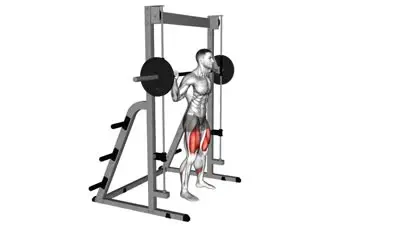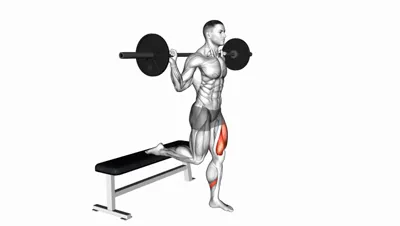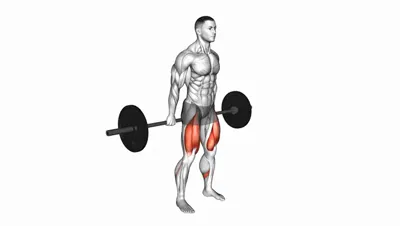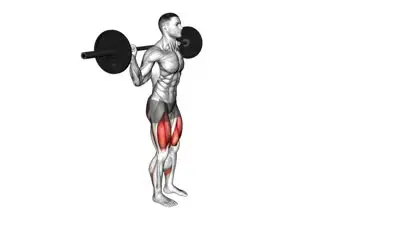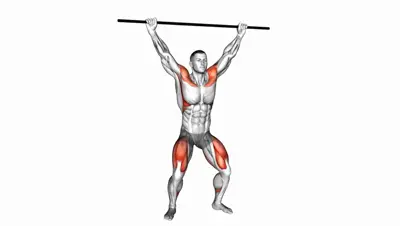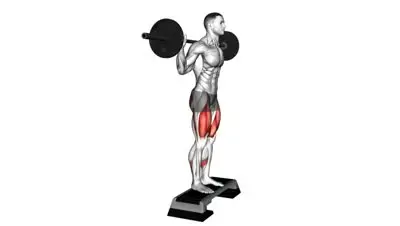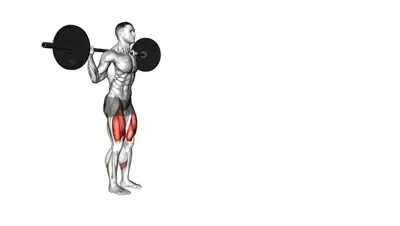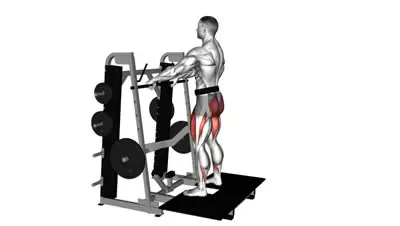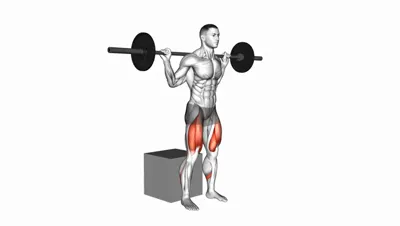

Description
The barbell back squat is the king of lower-body compound lifts and one of the three primary movements of powerlifting. It loads the quads, glutes and entire posterior chain through deep hip and knee flexion, demanding bracing strength from the core and upper back to keep the bar stable. Performed with a full range of motion, the back squat builds quad mass, hip drive and total-body strength faster than any machine alternative — and remains the single most studied exercise in resistance-training literature for hypertrophy and athletic carryover.
How to perform
- Set the bar on your back Set the bar in the rack at upper-chest height. Step under it and place the bar across your upper traps (high-bar) or rear delts (low-bar). Grip the bar slightly wider than your shoulders.
- Walk out and brace Stand up, take one or two short steps back, and set your feet shoulder-width apart with toes turned out 15–30°. Brace your core hard and take a deep belly breath.
- Break at hips and knees Initiate the descent by simultaneously breaking at the hips and knees. Sit down and back, keeping your chest proud and your knees tracking over your toes.
- Hit depth at parallel Descend until your hip crease is at or below the top of your knees (parallel or below). Keep the bar path vertical over the mid-foot.
- Drive out of the hole Drive through the entire foot — heels and big toe — and stand up by extending the hips and knees together. Do not let your chest collapse forward.
- Lock out and re-brace Lock out at the top with hips fully extended. Re-brace and breathe before the next rep.
Tips
- Treat every rep like a max — full brace, controlled descent, deliberate drive. Sloppy bracing on light sets builds bad habits.
- Squat in shoes with a hard, flat sole or dedicated lifting shoes. Running shoes destabilize the heel and rob power.
- Pause at the bottom for half a second — eliminates the stretch-reflex bounce and exposes weakness so you can fix it.
- Train the squat 2× per week — one heavier session (3–5 reps) and one moderate-volume session (5–10 reps) for fastest progress.
- Film your sets from the side every few weeks to verify depth and bar path.
Common mistakes
- Cutting depth above parallel — robs the quads and glutes of stretched-position tension and limits long-term gains.
- Knees caving inward (valgus collapse) — overloads the medial knee and signals weak external hip rotators. Cue: 'spread the floor with your feet'.
- Chest collapse / hip rise out of the hole — the lift becomes a good morning. Brace harder and keep your upper back tight.
- Heels rising off the floor — usually means tight ankles or a too-narrow stance. Widen the stance or use a slightly elevated heel.
- Holding the breath too long across multiple reps — re-brace and take a fresh breath at every lockout.
Recommended sets & reps
| Sets | Reps | RIR | |
|---|---|---|---|
| Strength | 3–5 | 3–6 | 1–2 |
| Hypertrophy | 2–3 | 6–9 | 1–2 |
| Endurance | 2–3 | 12–15 | 2–3 |
| Power | 3–5 | 3–5 | 1–2 |
These ranges are working sets only — add 1–2 progressive warm-up sets before each working set. Pair with 2× per week frequency to reach ~10–20 weekly sets per muscle group, the volume range supported by current evidence (Schoenfeld 2017, Pelland 2025).
Benefits
Builds quad and glute mass faster than any leg-press or machine alternative because the free-weight back squat demands stabilization across the entire body. Strengthens the entire posterior chain — erectors, hamstrings, calves — as a synergistic side-effect, transferring directly to deadlift performance and athletic explosiveness. Trains the core under heavy axial load, building bracing strength that no isolated ab work can replicate. Provides a clear, plate-loadable benchmark for tracking lower-body strength year over year. Improves bone density, hip mobility and movement quality with progressive overload over decades.
Frequently asked questions
How deep should I squat?
At least to parallel — the top of the thigh level with the top of the knee. Going below parallel ('ass to grass') loads the glutes and adductors more without injuring healthy knees. If your knees pain at depth, work mobility before adding load — pain at depth is almost always an ankle or hip restriction, not a knee structure issue.
Should I squat with a belt?
Use a belt above ~80% of your 1RM. Belt-less work below 80% builds stronger natural bracing and core musculature. A belt does not replace bracing — you brace into the belt, you do not let it brace for you.
Why do my knees cave inward?
Usually weak gluteus medius and external hip rotators. Cue 'spread the floor with your feet' on every rep, add band-resisted squats once per week to wake up the glutes, and check that your stance is wide enough — a stance too narrow forces knee valgus regardless of strength.
Barbell squat vs leg press for quads?
Barbell squat builds more total quad and glute mass per session because of the free-weight stabilization demand and longer time under tension. Leg press is a useful accessory for high-rep volume work without taxing the spine, but it should not replace the squat for primary compound work.
Educational guidance only — not a substitute for in-person coaching. Train within your ability and use a spotter for heavy attempts.