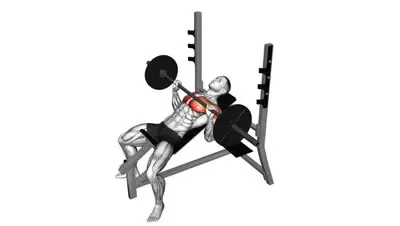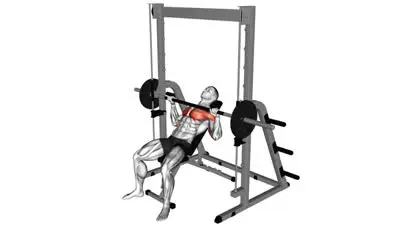

Description
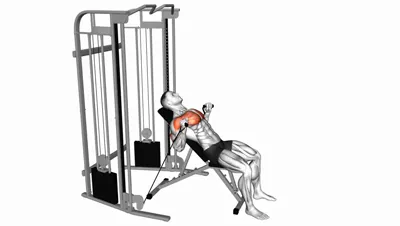
The incline dumbbell bench press targets the upper chest — the clavicular head of the pecs — by pressing from a bench set at 30 to 45 degrees with two independent dumbbells. The incline angle lines the press up with the upper-chest fibers, building the shelf of muscle that fills out the collarbone area and makes a chest look complete from every angle. Compared to the barbell incline, the dumbbells allow a deeper stretch, a natural converging press path and independent arm work, making this the default upper-chest builder in most hypertrophy programs.
How to perform
- Set the bench to thirty degrees Set an adjustable bench between 30 and 45 degrees — lower in that range biases more chest, higher brings more front delt.
- Kick the dumbbells up Sit with the dumbbells on your thighs, then lie back and drive them up one at a time with your knees until they sit over your upper chest.
- Anchor your shoulder blades Pull your shoulder blades back and down against the bench, plant your feet flat, and keep your ribs from flaring.
- Lower to the upper chest line Lower both dumbbells with elbows about 45 degrees from your torso until you feel a deep stretch, hands beside your upper chest.
- Press up and slightly inward Drive the dumbbells up along the incline path, letting them converge naturally over your face line without touching at the top.
- Finish the set safely After the final rep, bring the dumbbells to your thighs as you sit up with the knees — never drop them out to the sides.
Tips
- Start at 30 degrees — research and gym experience agree it captures the upper-chest benefit while keeping the front delts from taking over.
- Chase the deep stretch: lower two to three seconds until the pecs pull, because the lengthened position is the incline press's growth engine.
- Keep the dumbbells stacked over your elbows at every point — drifting toward your face or belly wastes pressing power.
- A slightly turned-in grip eases shoulder strain on the incline angle and feels stronger for most lifters.
- If your lower back arches off the bench to press, the load is too heavy — upper-chest work rewards strict reps, not leverage tricks.
Common mistakes
- Setting the bench too steep — beyond 45 degrees the front delts dominate and the upper chest fades from the movement; stay at 30–45 degrees.
- Turning it into a flat press — sliding the hips forward and arching hard flattens the effective angle and defeats the incline's purpose.
- Flaring the elbows to 90 degrees — straight-out elbows on an incline stress the shoulder joint; keep roughly a 45-degree tuck.
- Clanking the dumbbells overhead — slamming them together bleeds tension at the exact point of peak contraction.
- Bouncing out of the bottom stretch — rebounding under fatigue is how pec strains happen; control the turnaround.
Recommended sets & reps
| Sets | Reps | RIR | |
|---|---|---|---|
| Strength | 3–4 | 5–8 | 1–2 |
| Hypertrophy | 2–3 | 8–12 | 1–2 |
| Endurance | 2–3 | 12–15 | 2–3 |
| Power | 3–4 | 3–5 | 1–2 |
These ranges are working sets only — add 1–2 progressive warm-up sets before each working set. Pair with 2× per week frequency to reach ~10–20 weekly sets per muscle group, the volume range supported by current evidence (Schoenfeld 2017, Pelland 2025).
Benefits
Builds the upper chest, the region that determines whether a chest looks full from the collarbone down or only thick at the bottom. The incline angle recruits the clavicular pec fibers more strongly than flat pressing, while the dumbbells add a deeper loaded stretch — one of the strongest hypertrophy signals available. Independent arms correct the pressing imbalances a barbell hides, and the free path is kinder to the shoulders than a fixed bar at an incline. Strong front-delt and triceps involvement makes it a complete upper-body press that carries over to overhead strength.
Frequently asked questions
What incline angle is best for upper chest?
30 to 45 degrees is the productive window, and around 30 degrees is the sweet spot for most lifters — enough tilt to bias the clavicular fibers without handing the movement to the front delts. If your bench only has fixed notches, choose the lowest incline setting above flat.
Should I do incline before or after flat bench?
Do first whatever matters most to you, while you are fresh. Lifters with lagging upper chests benefit from leading their chest day with incline dumbbell presses and treating flat work as the second movement.
Why is incline pressing weaker than flat pressing?
The incline shortens the power contribution from the strongest mid and lower pec fibers and shifts more work to the smaller upper chest and front delts. Expect roughly 80–90 % of your flat dumbbell loads — that gap is anatomy, not weakness.
Incline dumbbell vs incline barbell press?
The dumbbell version offers a longer range of motion, a natural converging path and independent arm work, which most lifters find better for upper-chest growth and shoulder comfort. The barbell allows heavier absolute loads and simpler progression. For pure hypertrophy, dumbbells get the nod; for pressing strength, the bar.
Educational guidance only — not a substitute for in-person coaching. Train within your ability and use a spotter for heavy attempts.