
Description
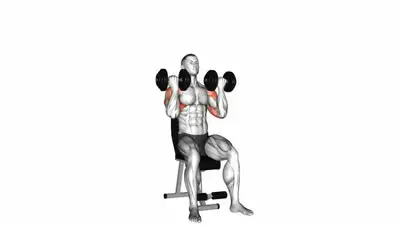
The seated dumbbell press is the mass-builder for the front and side delts — pressing two independent dumbbells overhead from a high-backed seat that removes leg drive and balance from the lift. The back support lets you focus everything on pressing, while the dumbbells demand stabilization, allow a natural converging path and work each shoulder on its own. The result is more delt isolation than a standing barbell press at loads that still climb steadily for years, which is why the seated dumbbell press anchors the pressing slot in most physique-oriented shoulder sessions.
How to perform
- Set the bench near vertical Set an adjustable bench to 80–90 degrees and sit with your whole back against the pad, feet planted wide and flat.
- Kick the dumbbells up Start with the dumbbells on your thighs, then drive them up to shoulder height one at a time with your knees.
- Find your start position Hold the dumbbells just above shoulder level, elbows slightly in front of your body, forearms vertical, core braced against the pad.
- Press up and slightly in Drive both dumbbells overhead until your arms are extended, letting them converge naturally above your head without clanking.
- Avoid the hard lockout slam Finish just short of slamming the elbows into full lockout, keeping tension on the delts at the top.
- Lower to ear level or below Lower the dumbbells under control until your elbows drop just below shoulder height, then press again.
Tips
- Keep your ribs down and your lower back close to the pad — a small natural arch is fine, a big bridge means the press has become an incline press.
- Elbows about 30 degrees in front of straight-out sideways is the strongest and most shoulder-friendly pressing plane for almost everyone.
- Lower at least until the elbows break shoulder height — half presses pump the ego and shrink the stimulus.
- A semi-neutral grip, palms turned slightly in, unloads cranky shoulders without costing pressing strength.
- Practice the knee kick-up with moderate weights early — getting heavy dumbbells into position is its own skill and the set starts there.
Common mistakes
- Arching off the backrest — sliding the hips forward and bridging turns the press into a fake incline bench and shifts the work to the upper chest.
- Flaring the elbows fully sideways — pressing in a pure T position crowds the shoulder joint under load; keep the elbows slightly forward.
- Stopping the descent at the ears — consistently short reps rob the delts of the stretch that drives most of their growth.
- Smashing the dumbbells together overhead — the clank costs tension, shakes stability and adds nothing but noise.
- Pressing with mismatched paths — one dumbbell drifting wide reveals a weak side; slow the tempo and let the weak arm set the pace.
Recommended sets & reps
| Sets | Reps | RIR | |
|---|---|---|---|
| Strength | 3–4 | 5–8 | 1–2 |
| Hypertrophy | 2–3 | 8–12 | 1–2 |
| Endurance | 2–3 | 12–15 | 2–3 |
| Power | 3–4 | 3–5 | 1–2 |
These ranges are working sets only — add 1–2 progressive warm-up sets before each working set. Pair with 2× per week frequency to reach ~10–20 weekly sets per muscle group, the volume range supported by current evidence (Schoenfeld 2017, Pelland 2025).
Benefits
Builds the front and side delts with heavier loads than most isolation work will ever allow, while the seat and backrest remove the balance and bracing limits of standing presses — the delts fail first, which is the point. Independent dumbbells expose and fix pressing imbalances and find each shoulder's natural groove, keeping the joint happier than a fixed bar over years of training. Triceps and upper-chest involvement make it an efficient upper-body builder beyond the shoulders. Easy to progress in small jumps across the dumbbell rack, it remains productive from novice to advanced.
Frequently asked questions
Seated dumbbell press vs standing barbell press?
The seated dumbbell version isolates the delts harder because the backrest removes leg drive and whole-body bracing, while the barbell builds more total-body strength and loads heavier overall. For shoulder size, the seated dumbbell press is the more direct tool; many programs run both.
How low should I lower the dumbbells?
Until your elbows drop just below shoulder height — roughly when the dumbbells reach ear level or a touch deeper, depending on your mobility. Deeper is fine if the shoulders stay pain-free; consistently shallow is the more common and more costly mistake.
Why do I always feel seated presses in my triceps?
The triceps finish every press, but if they fail first your range is probably too short — short reps live in the triceps-dominant top half. Lower deeper into the stretch, and consider one to two warm-up sets that let the delts wake up before the heavy work.
Should the bench be fully vertical?
Just shy of vertical — 80 to 85 degrees — is most comfortable for the shoulders and keeps the press honest. Reclining further than that progressively turns the movement into an incline chest press and changes which muscle does the work.
Educational guidance only — not a substitute for in-person coaching. Train within your ability and use a spotter for heavy attempts.