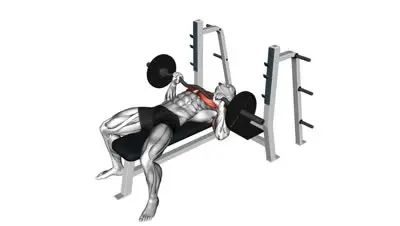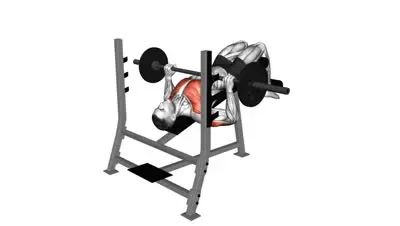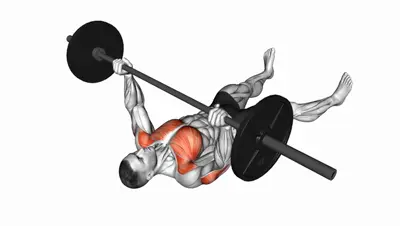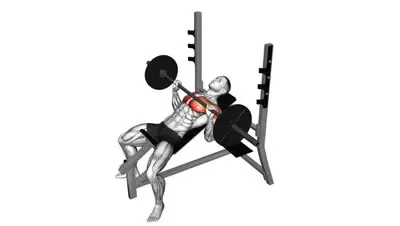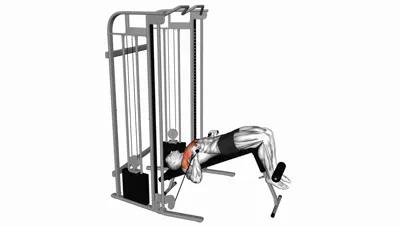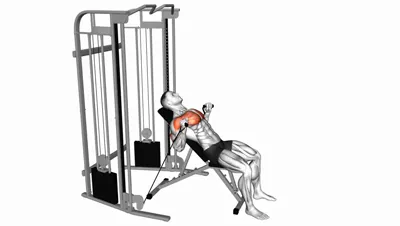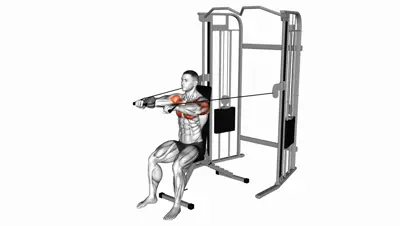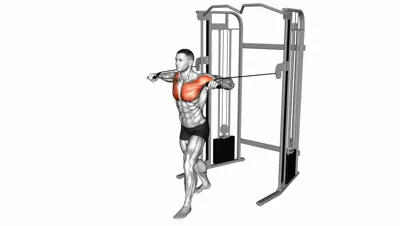

Description
The wide grip bench press moves your hands out to roughly one and a half times shoulder width, shortening the bar path and shifting more of the pressing work onto the pecs while reducing the triceps' contribution. The wider elbows-out position loads the chest at a longer muscle length, which is exactly what many lifters want for hypertrophy — but it also places more demand on the shoulders, making bar control and scapular position non-negotiable. Used with moderate loads and strict setup, it is a proven tool for pec-focused pressing volume; treated like a max-strength variation, it quickly becomes a shoulder complaint waiting to happen.
How to perform
- Set your shoulder blades first Lie on the bench with your eyes under the bar. Pull your shoulder blades down and together, plant your feet and keep your glutes on the pad.
- Take the wide grip deliberately Grip the bar about one and a half shoulder widths apart — for most lifters, one to two finger widths outside the rings. Wrists stay stacked over forearms.
- Unrack with straight arms Press the bar off the hooks and bring it over your upper chest with arms extended, keeping the shoulder blades pinned beneath you.
- Lower to your lower chest line Bring the bar down over two to three seconds toward the line of your lower chest, letting the elbows travel out at roughly 60–75 degrees from your torso.
- Touch and press without bouncing Touch the chest lightly — no bounce — then drive the bar back up along the same slightly arced path toward your starting position.
- Keep tightness through lockout Finish with arms extended and shoulder blades still retracted. Re-brace your grip and lats before the next rep begins.
Tips
- Use 5–10 percent less weight than your regular bench press — the shortened stroke tempts you to load up, but the shoulder position rewards restraint.
- Keep your shoulder blades pinned together from unrack to re-rack; losing retraction with a wide grip is what turns pec work into shoulder strain.
- Think about bending the bar toward your feet — the cue keeps your lats engaged and stops the elbows from flaring to a full 90 degrees.
- If the wide grip pinches the front of your shoulder even when warm, narrow the grip by one finger width at a time until it does not — grip width is a range, not a fixed point.
- Program it as your second or third press of the week at moderate reps, not as your max-effort movement.
Common mistakes
- Flaring the elbows to a full 90 degrees — elbows perpendicular to the torso with a wide grip put the shoulder in its most impingement-prone position; keep them at 60–75 degrees.
- Going as heavy as your normal bench — the shorter range does not compensate for the weaker shoulder position; wide grip pressing is a volume tool, not a PR tool.
- Bouncing the bar off the chest — the wide grip already loads the pecs at a long muscle length, and a bounce spikes that stress violently; touch and press smoothly.
- Letting the shoulders roll forward off the bench — lost scapular retraction moves the load from pecs to the front delt and shoulder capsule; stay pinned to the pad.
- Cutting the range short of the chest — stopping several centimeters high removes the stretch stimulus that justifies the wide grip in the first place; touch the chest under control.
Recommended sets & reps
| Sets | Reps | RIR | |
|---|---|---|---|
| Strength | 3–4 | 4–6 | 1–2 |
| Hypertrophy | 2–3 | 6–10 | 1–2 |
| Endurance | 2–3 | 12–15 | 2–3 |
| Power | 3–4 | 3–5 | 1–2 |
These ranges are working sets only — add 1–2 progressive warm-up sets before each working set. Pair with 2× per week frequency to reach ~10–20 weekly sets per muscle group, the volume range supported by current evidence (Schoenfeld 2017, Pelland 2025).
Benefits
Biases the pecs harder than a standard grip by reducing the triceps' leverage and loading the chest at a longer muscle length — a combination directly relevant to hypertrophy. The shortened bar path lets you accumulate pec-focused volume with slightly less total pressing work per rep, useful when your triceps are the limiting factor in chest training. Teaches disciplined scapular control, because the wide grip simply does not tolerate sloppy shoulder positioning — a form lesson that carries back to your regular bench. For powerlifters, spending blocks with a wider competition-style grip builds specific strength and confidence in the exact position they press from on the platform.
Frequently asked questions
Is the wide grip bench press bad for my shoulders?
Not inherently — the risk comes from combining a wide grip with 90-degree elbow flare, maximal loads and lost scapular retraction. Keep elbows at 60–75 degrees, shoulder blades pinned and loads moderate, and most lifters handle it well.
How much wider than normal should my grip be?
Roughly one and a half shoulder widths — typically one to two finger widths outside your regular grip, or near the rings on a standard bar. Find the widest position that stays pain-free rather than maxing out the bar markings.
Wide grip or regular grip for chest growth?
The wide grip shifts relative emphasis toward the pecs and away from the triceps, but the difference is a bias, not a transformation. Most lifters grow best using a regular grip for heavy work plus wide grip or dumbbell variations for extra pec volume.
Why is my wide grip bench weaker than my normal bench?
The wide position reduces triceps contribution and puts the shoulders at a mechanical disadvantage, so less weight is normal even though the bar travels a shorter distance. A 5–10 percent drop is typical.
Educational guidance only — not a substitute for in-person coaching. Train within your ability and use a spotter for heavy attempts.