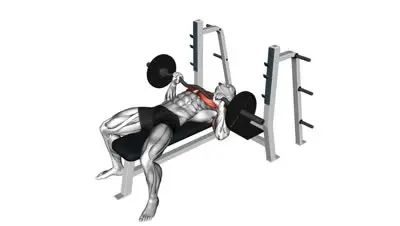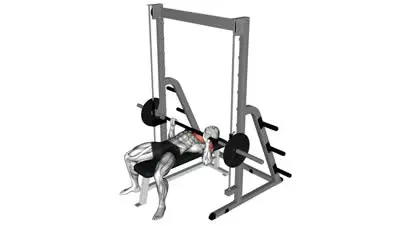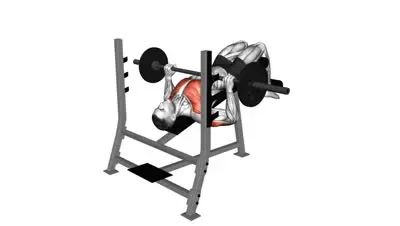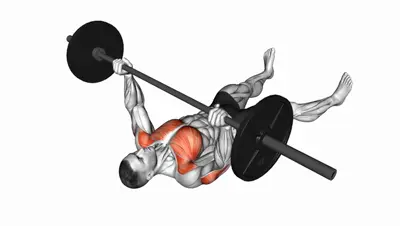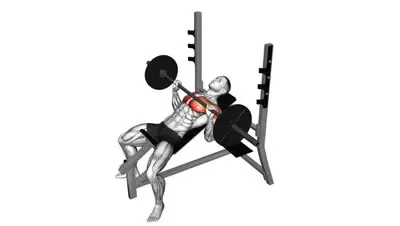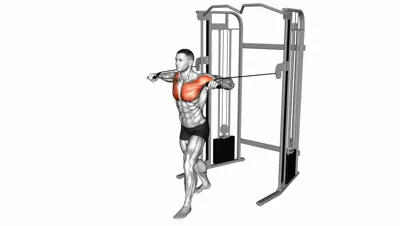

Description
The dumbbell bench press is the free-weight chest builder that trades the barbell's fixed bar path for two independent loads, giving each side of the chest its own range of motion and forcing the stabilizers to control every inch. The dumbbells travel deeper at the bottom and converge at the top, training the pecs through a longer arc than a barbell allows. Because each arm works alone, it exposes pressing imbalances and is gentler on cranky shoulders, making it both a primary press for hypertrophy and the standard second press behind the barbell bench.
How to perform
- Kick the dumbbells into position Sit on the bench with the dumbbells standing on your thighs. Lie back while driving the weights up with your knees, one at a time, so they arrive over your chest.
- Build your base Plant your feet flat, squeeze your shoulder blades together and down, and keep a slight natural arch — your upper back and glutes stay on the bench.
- Start stacked over the chest Hold the dumbbells over your mid-chest with wrists stacked above elbows, palms forward or turned slightly inward.
- Lower deep and controlled Lower both dumbbells with elbows about 45 degrees from your torso until you feel a strong pec stretch, hands roughly level with the sides of your chest.
- Press up and slightly together Drive the dumbbells up and let them converge naturally over your chest without clanking them together at the top.
- End the set safely After the last rep, bring your knees up and let the dumbbells ride down to your thighs as you sit up — never drop them outward from the bottom position.
Tips
- Treat the kick-up as part of the lift — practice it with moderate weight so heavy sets start in a stable, braced position instead of a scramble.
- Lower two to three seconds into the deepest pec stretch your shoulders allow comfortably; the extra range is the dumbbell press's main advantage over the bar.
- Keep your shoulder blades pinned back and down the entire set — the arms move, the shoulders stay anchored.
- A slightly turned-in (semi-neutral) grip often feels stronger and friendlier to the shoulders than strictly forward palms — both are valid.
- Stop the press just short of locked, touching elbows — slamming the dumbbells together at the top bleeds tension and wrecks your groove.
Common mistakes
- Flaring the elbows to 90 degrees — pressing with elbows straight out shifts stress onto the shoulder joint; keep roughly 45 degrees of tuck.
- Bouncing out of the stretch — ricocheting from the bottom uses passive tissue instead of pec contraction and risks a pec strain under fatigue.
- Pressing in two different grooves — letting one dumbbell drift wide while the other stays tight reveals an imbalance; slow the rep and match the paths.
- Lifting the feet or wiggling them mid-set — a moving base costs pressing stability and strength; plant the feet and leave them planted.
- Going so heavy the set ends with a dangerous bail — if you cannot return the dumbbells to your thighs under control, the load is beyond your working range.
Recommended sets & reps
| Sets | Reps | RIR | |
|---|---|---|---|
| Strength | 3–4 | 5–8 | 1–2 |
| Hypertrophy | 2–3 | 8–12 | 1–2 |
| Endurance | 2–3 | 12–15 | 2–3 |
| Power | 3–4 | 3–5 | 1–2 |
These ranges are working sets only — add 1–2 progressive warm-up sets before each working set. Pair with 2× per week frequency to reach ~10–20 weekly sets per muscle group, the volume range supported by current evidence (Schoenfeld 2017, Pelland 2025).
Benefits
Trains the chest through a longer range of motion than the barbell, with a deeper loaded stretch — a key driver of pec hypertrophy in current research. Each arm presses independently, so strength imbalances are exposed and corrected instead of hidden by a stronger side. The free dumbbell paths let the shoulders find their natural groove, which many lifters find more comfortable than a fixed bar. Heavy stabilizer demand builds pressing control that transfers to every other push. Requires no rack or spotter for moderate loads, and the same movement scales from light technique work to heavy top sets across decades of training.
Frequently asked questions
Why is my dumbbell bench so much weaker than my barbell bench?
Expect the pair of dumbbells to total roughly 70–80 % of your barbell load. Each arm must stabilize its own weight, the kick-up costs energy, and the deeper range lengthens the working stroke — that gap is normal and shrinks slightly with practice.
How deep should I lower the dumbbells?
Lower until you feel a strong but pain-free stretch across the chest, typically with hands around the level of your torso's sides. The dumbbell press exists to use this extra range — but depth should never come with shoulder pain or losing shoulder-blade position.
Dumbbell vs barbell bench press — which should I do?
Use the barbell when maximal pressing strength and easy progressive loading are the goal, and the dumbbell version for a longer range, more balanced development, and friendlier shoulder mechanics. Most well-built programs run both — one as the primary press, the other as the secondary.
How do I get heavy dumbbells into position safely?
Use the knee kick-up: start with the dumbbells upright on your thighs, lie back while driving one knee at a time upward, and receive the weights over your chest. Reverse the motion to finish the set — and ask for a hand-off only when the dumbbells get truly heavy.
Educational guidance only — not a substitute for in-person coaching. Train within your ability and use a spotter for heavy attempts.