
Description
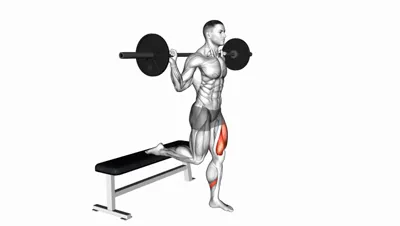
The dumbbell Bulgarian split squat is a rear-foot-elevated single-leg squat that trains the quads and glutes of the front leg through a deep, stable range of motion. With the back foot resting on a bench, nearly all load shifts onto the working leg, exposing and correcting left-right strength imbalances that bilateral squats hide. Because the torso stays relatively upright and spinal loading is low, it delivers heavy leg stimulus without the axial fatigue of a barbell back squat — one reason it has become a staple in modern hypertrophy and athletic programs.
How to perform
- Set up your split stance Stand about two to three feet in front of a knee-high bench, facing away. Place the top of your rear foot on the bench and hold a dumbbell in each hand at your sides.
- Square your hips forward Keep both hips pointing straight ahead and your front foot flat, far enough forward that your knee tracks over your mid-foot at the bottom.
- Brace and lower under control Brace your core and lower your rear knee toward the floor, letting your front knee travel forward naturally. Keep a slight forward torso lean to load the glutes.
- Reach depth without collapsing Descend until your front thigh is at least parallel to the floor and your rear knee hovers just above it. Do not let the front heel lift or the knee cave inward.
- Drive through the front foot Push hard through the whole front foot to stand back up, keeping the rear leg passive — it balances, it does not push.
- Finish the set, then switch legs Complete all reps on one leg before switching. Start each set with your weaker leg and match that rep count on the stronger side.
Tips
- Find your stance distance with an empty-handed rehearsal set — closer biases the quads, further forward biases the glutes and hamstrings.
- Fix your eyes on a spot on the floor a few feet ahead; a wandering gaze is the most common reason for losing balance.
- Keep a slight, consistent forward torso lean — it loads the glutes and keeps the front knee happy without turning the rep into a good morning.
- If balance limits you before leg fatigue does, hold one dumbbell on the working-leg side and use the free hand for light support.
- Lower for a controlled two to three seconds — the stretched bottom position is where most of the hypertrophy stimulus lives.
Common mistakes
- Standing too close to the bench — this forces an upright shin, jams the front knee past the toes and turns the rep into a balance fight instead of a leg builder.
- Pushing off the rear foot — the back leg should only stabilize; driving from it unloads the working leg and defeats the single-leg purpose.
- Letting the front knee cave inward — hip and glute fatigue shows up as valgus collapse; track the knee over the second toe on every rep.
- Twisting the hips open — rotating toward the rear leg shortens the range of motion and shifts stress to the lower back; keep both hip bones facing forward.
- Bouncing out of the bottom — ricocheting off the stretched position robs tension from the quads and irritates the rear hip flexor.
Recommended sets & reps
| Sets | Reps | RIR | |
|---|---|---|---|
| Strength | 3–4 | 5–8 | 1–2 |
| Hypertrophy | 2–3 | 8–12 | 1–2 |
| Endurance | 2–3 | 12–15 | 2–3 |
| Power | 3–4 | 3–5 | 1–2 |
These ranges are working sets only — add 1–2 progressive warm-up sets before each working set. Pair with 2× per week frequency to reach ~10–20 weekly sets per muscle group, the volume range supported by current evidence (Schoenfeld 2017, Pelland 2025).
Benefits
Builds the quads and glutes with near-bilateral squat intensity while loading the spine with a fraction of the weight, making it one of the best stimulus-to-fatigue choices in lower-body training. Exposes and corrects side-to-side strength gaps that two-legged squats mask, which carries over directly to sprinting, jumping and change of direction. The deep stretched position under load is a powerful hypertrophy trigger for the quads and glutes. Trains single-leg balance and hip stability that protect the knees in sport and daily life. Requires only two dumbbells and a bench, so it scales from home gyms to heavy gym sessions for years of progression.
Frequently asked questions
Why do Bulgarian split squats feel harder than regular squats?
One leg does almost all the work while also stabilizing, so the local muscle stress per leg is higher even with much lighter total load. The balance demand and the deep stretch on the rear hip flexor add to the perceived difficulty — that discomfort is normal and improves within a few sessions.
Should my rear foot be flat or toes-down on the bench?
Both work. Resting the shoelaces flat on the bench is more stable and comfortable for most lifters, while the toes-down position allows a bit more rear-leg push for balance. Pick the one that lets you load the front leg hardest and stay consistent with it.
Are Bulgarian split squats good for beginners?
Yes, with patience — master the bodyweight version first, then add dumbbells once you can do 10 controlled reps per leg. Beginners gain balance and single-leg strength quickly, and the movement teaches squat mechanics with very low spinal load.
How much weight should I use compared to my squat?
Expect to hold roughly 20–40 % of your barbell squat load as total dumbbell weight at matched effort. Progress by adding 2–4 kg / 5–10 lb total when you hit the top of your rep range with one to two reps in reserve.
Educational guidance only — not a substitute for in-person coaching. Train within your ability and use a spotter for heavy attempts.