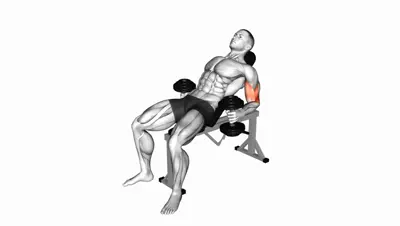

Description
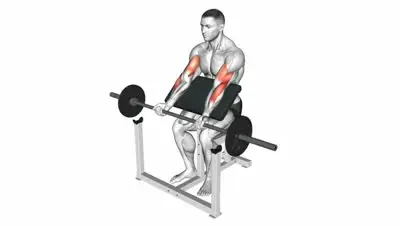
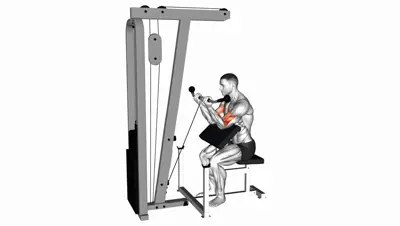
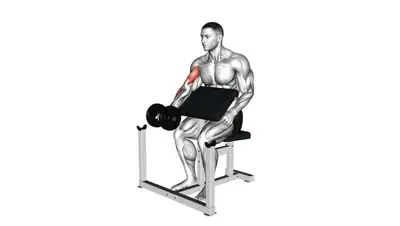
The machine preacher curl locks your upper arms on an angled pad and lets you curl against a guided cam — the strictest biceps isolation in the gym. With the armpits anchored over the pad, the shoulders cannot swing, the elbows cannot drift, and the machine's resistance curve keeps tension on the biceps even in the stretched bottom position where dumbbells go light. That stretch emphasis is exactly where current hypertrophy research points, and the machine version makes training that zone close to failure safer than any free-weight preacher variation.
How to perform
- Set the seat height Adjust the seat so your armpits sit snugly over the top edge of the pad with your upper arms flat against it.
- Grip the handles arms-long Take the handles with an underhand grip, arms almost fully extended down the pad and a soft bend protecting the elbows.
- Pin your arms to the pad Press the back of your upper arms into the pad — they stay welded there from the first rep to the last.
- Curl to peak contraction Curl the handles up until your forearms are just short of vertical and the biceps are fully squeezed.
- Hold the squeeze briefly Pause for a beat at the top with maximum biceps tension, without lifting the elbows or shrugging.
- Lower deep and slow Lower the handles over two to three seconds back to a long, controlled stretch — stopping just before the elbows snap straight.
Tips
- Respect the bottom position: the deep stretch under load is the preacher's special weapon, and rushing through it throws away the best part of the machine.
- Stop the curl just short of vertical forearms — past that point the machine arm carries the load and the biceps tension drops to nothing.
- Drive the back of the arms into the pad all set; the instant the elbows lift, the front delts join in and the isolation is gone.
- The stretched position is brutal and strength drops fast there — choose a load by the bottom third of the rep, not the easy top.
- Add a deliberate two-second negative on the last reps of each set; eccentric stretch under control is where preacher curls earn arm size.
Common mistakes
- Letting the elbows lift off the pad — raising the arms recruits the shoulders and converts a strict curl into a cheat curl with extra steps.
- Sitting too high or too low — a wrong seat height puts the armpits off the pad edge, the geometry breaks, and either the stretch or the squeeze disappears.
- Slamming into full extension at the bottom — the stretched biceps tendon does not appreciate a loaded snap; control the last degrees instead of crashing into them.
- Curling past vertical — cranking the handles to the chin only folds the machine arm over; tension peaks just before vertical and vanishes beyond it.
- Half-repping the top half only — the easy upper range pumps but skips the stretch, which is precisely the zone that makes preacher work worth doing.
Recommended sets & reps
| Sets | Reps | RIR | |
|---|---|---|---|
| Strength | 3–4 | 8–10 | 1–2 |
| Hypertrophy | 3–4 | 8–12 | 1–2 |
| Endurance | 2–3 | 12–15 | 2–3 |
| Power | 3 | 8–10 | 2–3 |
These ranges are working sets only — add 1–2 progressive warm-up sets before each working set. Pair with 2× per week frequency to reach ~10–20 weekly sets per muscle group, the volume range supported by current evidence (Schoenfeld 2017, Pelland 2025).
Benefits
Isolates the biceps more strictly than any free-weight curl because the pad mechanically removes shoulder swing and elbow drift — every rep is honest. Emphasizes the stretched position of the biceps, the range that recent hypertrophy research highlights as the most growth-productive, while the machine keeps that vulnerable position safe to load. Training close to failure is low-risk: at the end of a set you simply set the weight down, which makes the machine ideal for intensity techniques. The guided path also builds the mind-muscle connection that lifters then carry back to dumbbell and barbell curls.
Frequently asked questions
What's the difference between preacher curls and regular curls?
The pad. Anchoring the upper arms in front of the body removes momentum and shifts emphasis toward the lower, stretched range of the curl. Standing curls allow more load and a natural arc, while preacher curls deliver stricter isolation and a harder stretch stimulus — programs benefit from both.
Why are preacher curls so much harder at the bottom?
The pad angle places peak leverage on the biceps when the arm is nearly straight — exactly where the muscle is weakest and most stretched. That is by design: hard work in the lengthened position is what makes the preacher curl such an effective growth tool.
Machine preacher curl vs EZ-bar preacher curl?
The machine keeps tension through the entire arc thanks to its cam, and failing a rep is completely safe. The EZ-bar version offers free-weight loading but loses tension near the top and punishes failure in the stretched position. For most lifters the machine is the better hypertrophy tool, the bar a fine variation.
Should preacher curls go all the way down?
Yes — to within a few degrees of straight, under control. The deep stretch is the point of the exercise; what you should avoid is bouncing or snapping into the locked-out position with heavy weight, which stresses the distal biceps tendon.
Educational guidance only — not a substitute for in-person coaching. Train within your ability and use a spotter for heavy attempts.