
Description
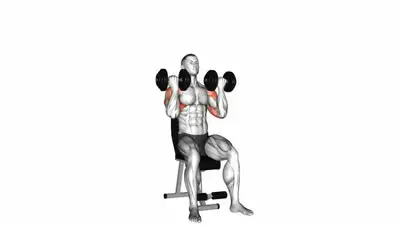
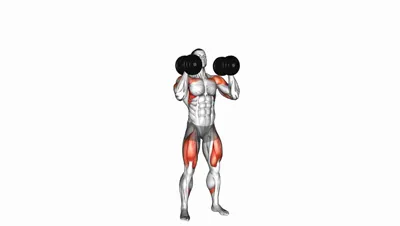
The standing dumbbell press is a strict overhead press performed on your feet with two independent dumbbells, making it as much a full-body stability exercise as a shoulder builder. Without a bench or backrest, your core, glutes and spinal erectors must hold your torso rigid while the delts and triceps drive the weight overhead — and the dumbbells add a stabilization demand a barbell never has. Compared to the seated dumbbell press, you lift somewhat less weight, but you build pressing strength that transfers directly to real life, where nothing you lift overhead comes with a chair.
How to perform
- Clean the dumbbells to your shoulders Stand with feet shoulder-width apart and lift the dumbbells to shoulder height, palms facing forward or slightly turned in, elbows under your wrists.
- Brace your whole body Squeeze your glutes, brace your abs and keep your ribs down — this locks your spine in a neutral position before any weight moves overhead.
- Press straight up overhead Drive both dumbbells up and slightly inward until your arms are extended overhead, with your biceps roughly beside your ears at the top.
- Keep your ribs stacked at lockout At the top, your hips, shoulders and wrists should stack in one vertical line — do not let your lower back arch as the weight passes your head.
- Lower under full control Bring the dumbbells back to shoulder height over two to three seconds, keeping your elbows tracking under your wrists rather than flaring out.
- Reset your brace between reps Re-tighten your glutes and abs briefly before each rep — the brace fades as sets get hard, and that is when the lower back starts to overextend.
Tips
- Squeeze your glutes as hard as you can through every rep — it is the single most effective cue to stop the lower back from arching under load.
- Press the dumbbells up and slightly toward each other; a natural arc that finishes over your ears keeps the load on the delts instead of drifting forward.
- If you tend to lean back, try a staggered stance with one foot half a step behind — it reduces the arch without changing the pressing mechanics.
- Expect to press less than seated — that is the stability cost, not weakness. Judge progress against your own standing numbers only.
- Exhale forcefully through the sticking point just above your head while keeping your core braced — do not dump all your air at once.
Common mistakes
- Arching the lower back to finish reps — leaning back turns the movement into an incline press and compresses the lumbar spine; brace glutes and abs, or lower the weight.
- Using leg drive on a strict press — dipping and bouncing with the knees turns the exercise into a push press and hides pressing weakness; keep knees firm but not locked.
- Flaring the elbows out to the sides — elbows drifting away from under the wrists stress the shoulder and leak pressing force; keep forearms vertical throughout.
- Pressing the dumbbells forward instead of up — finishing with the weights in front of your head keeps constant strain on the front delts and pulls you off balance; finish over your ears.
- Rushing the descent — dropping the dumbbells back to the shoulders wastes the eccentric stimulus and makes the catch position jarring; lower in two to three controlled seconds.
Recommended sets & reps
| Sets | Reps | RIR | |
|---|---|---|---|
| Strength | 3–4 | 5–8 | 1–2 |
| Hypertrophy | 2–3 | 8–12 | 1–2 |
| Endurance | 2–3 | 12–15 | 2–3 |
| Power | 3–4 | 3–5 | 1–2 |
These ranges are working sets only — add 1–2 progressive warm-up sets before each working set. Pair with 2× per week frequency to reach ~10–20 weekly sets per muscle group, the volume range supported by current evidence (Schoenfeld 2017, Pelland 2025).
Benefits
Builds shoulder size and pressing strength while simultaneously training the core, glutes and upper back to stabilize an overhead load — a combination no seated or machine press replicates. The independent dumbbells strengthen each side separately, preventing the stronger arm from quietly compensating the way it can with a barbell. Develops overhead mechanics that carry over directly to daily life and sport, since standing is how you actually lift things overhead outside the gym. Improves full-body rigidity and rib-cage control under load, which pays off in every other standing lift — squats, rows and carries all benefit from the bracing skill the standing press forces you to learn.
Frequently asked questions
Standing or seated dumbbell press — which should I do?
Seated lets you lift more and isolates the delts harder; standing trains the whole body and builds more transferable strength. Both work — many programs use standing as the main press and seated for extra volume.
Why can I press so much less standing than seated?
Standing removes the backrest, so your core and glutes must generate all the stability a bench normally provides. A 10–20 percent drop compared to seated pressing is completely normal.
Is the standing dumbbell press safe for my lower back?
Yes, if you brace correctly — squeeze your glutes, keep ribs down and stop the set when you feel your back starting to arch. The exercise itself teaches exactly the bracing that protects your spine.
How is it different from a barbell overhead press?
The dumbbells move independently, so each shoulder stabilizes and presses on its own — more stabilizer work and a freer arc, but less total load. The barbell allows heavier absolute weights; the dumbbells expose asymmetries.
Educational guidance only — not a substitute for in-person coaching. Train within your ability and use a spotter for heavy attempts.