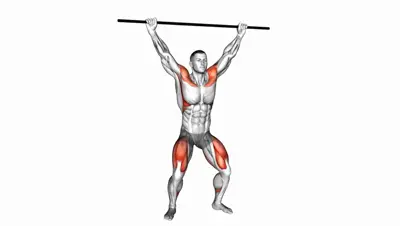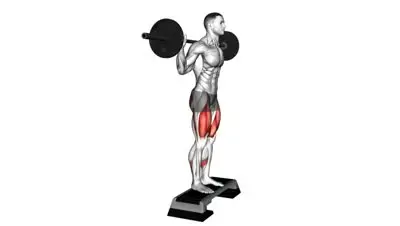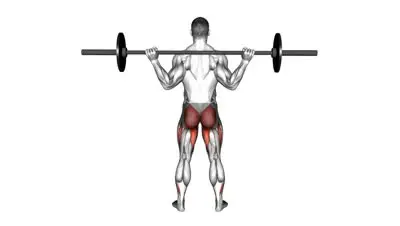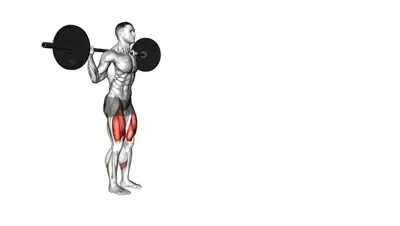

Description
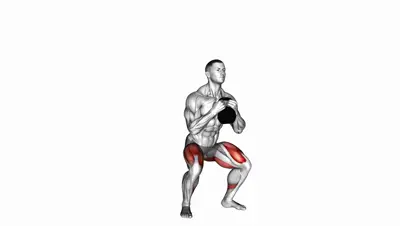
The dumbbell goblet squat is a front-loaded squat with a single dumbbell held vertically at the chest — the most effective way ever devised to teach squat mechanics while still training the quads, glutes and core hard. The front-loaded weight acts as a counterbalance, letting you sit deep between your heels with an upright torso that keeps the knees tracking and the back neutral almost automatically. From complete beginners learning the pattern to advanced lifters squeezing out high-rep finisher sets, the goblet squat earns its place in every program.
How to perform
- Cradle the dumbbell at your chest Hold one dumbbell vertically against your chest, both palms cupping the top head like a goblet, elbows pointing down.
- Take your squat stance Set your feet shoulder-width or slightly wider, toes turned out ten to thirty degrees, weight spread across the whole foot.
- Brace before you descend Take a breath into your belly, brace your core, and keep your chest tall — the dumbbell stays glued to your sternum.
- Sit straight down between your heels Bend hips and knees together, pushing the knees out along the line of the toes, descending as deep as your mobility allows.
- Find depth with elbows inside knees At the bottom, your elbows track just inside your knees — gently pressing them out — with heels planted and torso upright.
- Drive up through the whole foot Stand by pushing the floor away, knees tracking over the toes, exhaling through the sticking point and finishing tall.
Tips
- Hug the dumbbell tight to your chest for the whole set — the moment it drifts forward, your upper back rounds and your shoulders fry before your legs.
- Use the bottom position as a mobility drill: pause two to three seconds, breathe, and gently pry the knees out with the elbows.
- Push the knees out along the toe line from the first inch of descent — the goblet squat rewards an aggressive knees-out pattern.
- Slow eccentrics pay double here: three seconds down builds quad size and grooves the cleanest squat pattern you will ever practice.
- When one dumbbell stops being heavy enough at 15 or more clean reps, treat that as your cue to graduate to front squats or barbell squats rather than chasing giant dumbbells.
Common mistakes
- Holding the dumbbell away from the body — even a few centimeters of drift multiplies the demand on arms and upper back and tips the torso forward.
- Lifting the heels at depth — weight rolling onto the toes means the stance is too narrow or mobility is not there yet; elevate the heels slightly or shorten the range.
- Letting the knees cave inward on the way up — valgus collapse under fatigue is the most common goblet-squat fault; push the floor apart with your feet.
- Rounding the upper back as reps get hard — the goblet's front load punishes a collapsed chest; keep the elbows down and sternum proud.
- Cutting depth when the weight feels heavy — the goblet squat's value lives below parallel; lighten the load before you shorten the range.
Recommended sets & reps
| Sets | Reps | RIR | |
|---|---|---|---|
| Strength | 3–4 | 6–8 | 1–2 |
| Hypertrophy | 2–3 | 8–12 | 1–2 |
| Endurance | 2–3 | 12–20 | 2–3 |
| Power | 3–4 | 3–5 | 1–2 |
These ranges are working sets only — add 1–2 progressive warm-up sets before each working set. Pair with 2× per week frequency to reach ~10–20 weekly sets per muscle group, the volume range supported by current evidence (Schoenfeld 2017, Pelland 2025).
Benefits
Teaches textbook squat mechanics faster than any other variation because the front-loaded counterbalance makes depth, knee tracking and an upright torso feel natural from rep one. Builds real quad and glute size in beginners and serves advanced lifters as a brutal high-rep or tempo tool. The braced, upright hold doubles as loaded core and upper-back training. Joint-friendly and almost impossible to get badly wrong, it carries a fraction of the injury risk of loaded barbell variations while teaching the same pattern. One dumbbell and two square meters are all it needs — home gym, hotel gym or warm-up platform.
Frequently asked questions
Are goblet squats good for beginners?
They are arguably the single best beginner squat. The counterbalance teaches depth and balance automatically, the load is self-limiting, and bailing out is as simple as setting the dumbbell down. Most coaches start new lifters here before any barbell work.
How heavy should a goblet squat be?
Start around 10–15 kg / 25–35 lb and add weight whenever you finish the top of your rep range with reps in reserve. Once clean sets of 15 or more with the heaviest comfortable dumbbell stop challenging your legs, transition the pattern to front squats or barbell back squats.
Goblet squat vs barbell squat — what's the difference?
The goblet squat is front-loaded, lighter and self-correcting — ideal for learning, warm-ups and higher-rep quad work. The barbell squat allows far heavier progressive loading for long-term strength. They are sequential tools, not competitors: master the goblet, then add the bar.
Why do my arms tire before my legs?
Either the dumbbell has drifted away from your chest or the load has outgrown the exercise. Hug the bell to your sternum with elbows down, and if upper-body fatigue still ends sets first, it is time to move the pattern to a front squat.
Educational guidance only — not a substitute for in-person coaching. Train within your ability and use a spotter for heavy attempts.