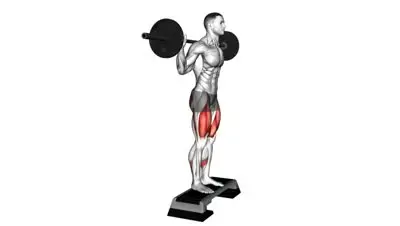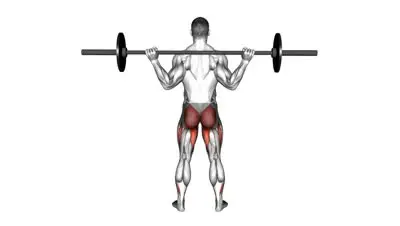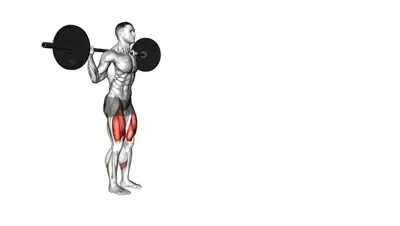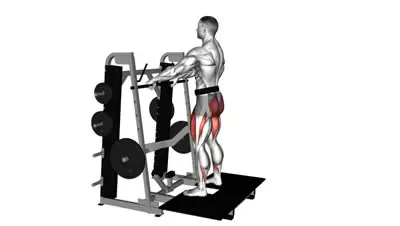

Description
The machine leg extension is the only common exercise that isolates the quadriceps completely — seated with the pad on your shins, you extend the knees against the stack and nothing else in the body can help. That isolation matters more than it looks: the rectus femoris, the quad that crosses the hip, contributes little during squats and leg presses, and grows reliably only with extension work. From physique training to knee rehab to pre-exhausting before squats, the leg extension is the precision tool of quad development — judged not by stack weight but by the quality of the squeeze.
How to perform
- Align your knees with the pivot Sit deep in the seat and adjust it so your knee joints line up with the machine's axis of rotation.
- Set the shin pad low Place the pad on the front of your ankles just above the feet, and set the backrest so your thighs rest fully on the seat.
- Grip and brace Hold the side handles, press your back into the pad, and keep your hips planted — they stay down for every rep.
- Extend to full lockout Straighten both knees until the legs are completely extended — the final degrees are where the quads contract hardest.
- Squeeze at the top Hold the fully extended position for a full second, quads flexed as hard as you can.
- Lower slow and deep Return the pad in two to three seconds to a deep knee bend, keeping tension just shy of the stack touching down.
Tips
- Full extension is the point of the exercise — the last fifteen degrees recruit the quads hardest, so lock out every rep and hold the squeeze.
- Use the seat like a harness: hips pinned, back pressed in, hands on the handles — the quieter your body, the louder your quads.
- Slow eccentrics multiply the stimulus; three seconds down at moderate weight beats stack-slamming at heavy weight in every measurable way.
- Point your toes straight up as the default; small in-or-out rotations shift emphasis between the inner and outer quad slightly, but consistency beats tinkering.
- Leg extensions are the safest place in leg training to chase a real burn — long sets of 15–20 with a top squeeze are a legitimate growth tool, not junk volume.
Common mistakes
- Letting the hips rise off the seat — bucking upward to move the stack turns quad isolation into a full-body heave and grinds the knees.
- Stopping short of lockout — skipping the final degrees skips the rectus femoris' hardest work and most of the exercise's value.
- Dropping the weight on the descent — a crashing stack means the eccentric never happened, and the eccentric is half the rep.
- Misaligned knees — sitting too far forward or back puts shear on the joint instead of clean rotation; take ten seconds to set the seat properly.
- Loading so heavy the squeeze disappears — if you cannot pause at the top, the number on the stack is writing checks your quads aren't cashing.
Recommended sets & reps
| Sets | Reps | RIR | |
|---|---|---|---|
| Strength | 3–4 | 8–10 | 1–2 |
| Hypertrophy | 3–4 | 10–15 | 1–2 |
| Endurance | 2–3 | 15–20 | 2–3 |
| Power | 3 | 8–10 | 2–3 |
These ranges are working sets only — add 1–2 progressive warm-up sets before each working set. Pair with 2× per week frequency to reach ~10–20 weekly sets per muscle group, the volume range supported by current evidence (Schoenfeld 2017, Pelland 2025).
Benefits
Isolates the quadriceps with zero contribution from glutes, back or balance — pure knee extension that makes every rep traceable to the target muscle. Uniquely valuable for the rectus femoris, which squats and presses largely bypass; extensions are the most reliable way to develop it. The fixed path and adjustable range make it a cornerstone of knee rehabilitation as strength returns after injury. As a pre-exhaust before squats or a finisher after them, it adds quad volume without any systemic fatigue, and the detailed, separated look of well-developed quads is built almost nowhere else.
Frequently asked questions
Are leg extensions bad for your knees?
For healthy knees, no — current evidence shows controlled extensions strengthen the joint's supporting structures, and the movement is a staple of knee rehab worldwide. The realistic risks are excessive load with slamming tempo and a misaligned seat, both of which are technique choices, not properties of the machine.
What do leg extensions work that squats don't?
The rectus femoris — the central quad that crosses the hip — stays largely inactive during squats and leg presses because it shortens at both ends. Extension work loads it directly, which is why lifters who never extend often show a visible gap in the middle of otherwise strong quads.
How heavy should leg extensions be?
Heavy enough to challenge the quads in the 10–15 rep range, light enough to hold a one-second squeeze at full lockout on every rep. The machine rewards tension quality over stack numbers — when the pause disappears, you have left the productive zone.
Should I point my toes in or out on leg extensions?
Straight up is the default and trains the whole quad evenly. Toes slightly out bias the inner quad, slightly in bias the outer sweep — the differences are real but modest. Pick the neutral position, progress consistently, and treat rotations as seasoning rather than strategy.
Educational guidance only — not a substitute for in-person coaching. Train within your ability and use a spotter for heavy attempts.